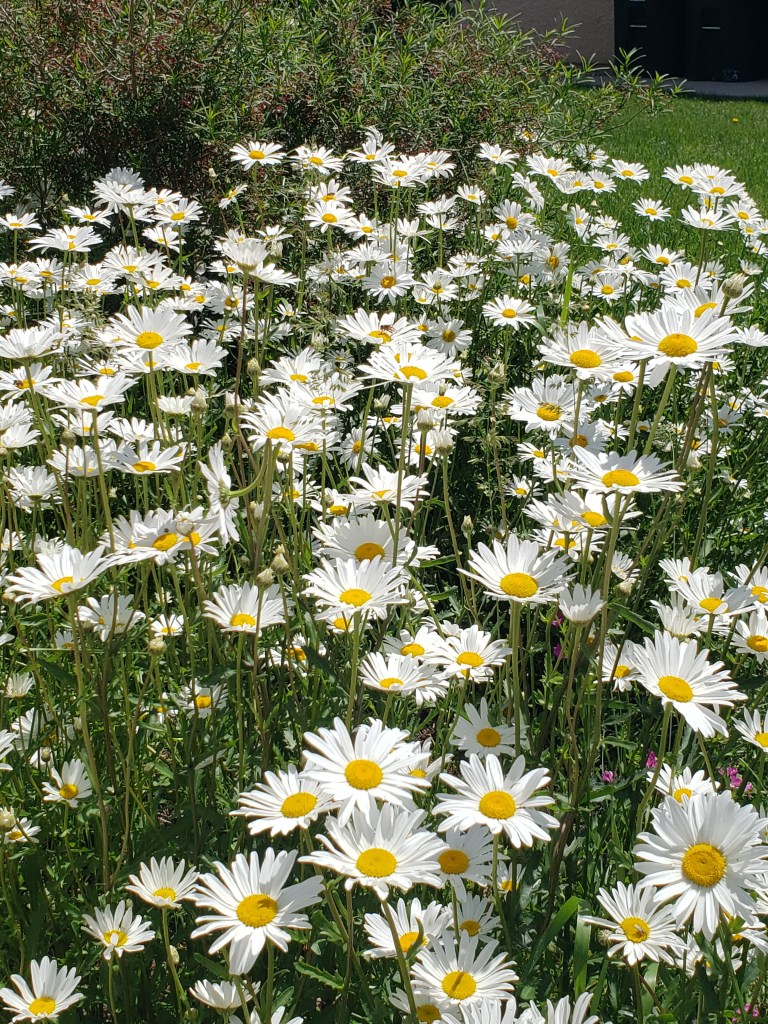
Every year, in all my years working at garden centers, people came with photos of their beds and borders. They are not happy; their beds look empty, stingy or lackluster is the complaint. Typically, they will have one of this shrub, one of that shrub and a two or three different perennials. They wished for something more…lush? Full? They don’t want to look at all the soil or mulch.
One of the best pieces of advice I received when we first moved to the farm was from a member of the local garden club, famous for her abundant borders. She told me to plant so densely that weeds could not even get started. And don’t be afraid of big plants.
Especially when it comes to perennials, people buy one of their chosen plant. Most perennials will get to a width of maybe a foot giving you, once they are mature, a head of flowers that will fill your hands. If you want an armful of flowers, you must plant multiples of that perennial. This is known as a drift. Drifts should be in odd numbers, they can be planted in a circle, triangle or in a line within the bed. Within a few years you cannot tell where one plant begins, they grow into one large clump.
So often in Spring I see individual tulips or daffodils poking out of the emerging foliage of a perennial border. There is one here, another a foot over, another there. Once blooming they look a little lost. Planted in a drift, they have much more impact. Perennials such as daisy,(Leucanthemum), coneflower (Echinacea), salvia (Salvia) and brown-eyed Susan (Rudbeckia), just to name a few, look far more spectacular planted in a drift. Even grasses look showier planted in drifts.
If you’re trying to attract pollinators, a drift will have more power of attraction. If you want cut flowers you can remove some from a drift and the drift will still look good. Lots of good reasons to plant in multiples.
 Peace Signs and Pruners
Leave a comment