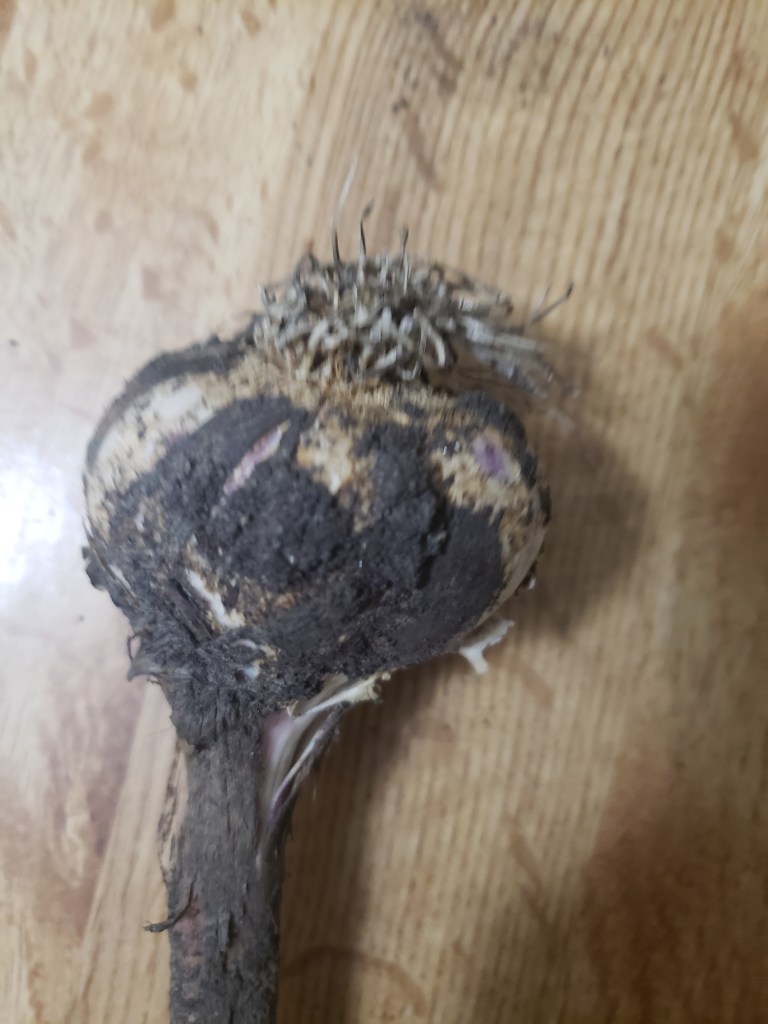
How’s your garlic crop? Looking good? Leaves dying back? It’s time to harvest. For us in Zone 3 harvest is usually early to mid-August. Digging the bulbs is the hard work, but the work isn’t finished once you have everything out of the ground. If you want to enjoy your homegrown garlic all winter, you’ve got to cure it.
Testing a few heads is always a good idea. Bulbs should be firm, garlic cloves filling the papery covering. As with all things in the vegetable garden, sufficient water during growing will give you a bigger product. Always loosen the soil with a spade, fork or trowel; do not pull heads as you can damage the stem which allows rot and fungal infections in. Treat these bulbs like gold – which they are worth their weight in! Be very gentle, don’t hit them or ding them!
Do not, do not, do not, may I repeat: Do Not hose them down or rinse them off! Getting water on the bulbs invites rot: moisture can get into the root crown, under the papery cover of the cloves or into the stem. Do leave them dirty and leave them to air dry. They do not need to be in sun which can dehydrate the bulbs. Find a dim, cool area with good air circulation. If you don’t believe the air circulation is good put a fan on the area.
I’ve always cured garlic and onions by simply laying them out on a table, often in the garage. I turn them regularly because rot will start where the bulb is in constant contact with the table. This is true of winter squash, potatoes and root vegetables. You can hang the produce or lay it on mesh screens, lessening the chances of contact rot. The curing process can take up to two weeks, if your weather is humid. The dirt should fall off or brush off easily. It’s when the curing is finished that I trim the roots and stems.
Keep any produce that is dinged, stabbed or bruised for immediate eating, they will not store well. Cured garlic can last in a cool, dark space for months; the temperature, ideally, is around 12o C or 55o F. Warmer temperatures will cause them to desiccate or sprout to soon.
Here on the Prairies we typically grow a hardneck garlic, which is a little tougher than soft neck garlics. This includes varieties such as Music, Purple Stripe, Porcelain and Rocambole. Hardneck garlics give us the delightful scapes in late spring, softnecks do not. Softneck garlics can be braided, hardnecks can not. Colder climates can grow softneck garlics such as Artichoke or Silverskin but plant a little deeper, mulch well and delay removing the mulch in Spring for as long as possible. I find the hardneck garlics more flavorful; I only tried to grow the softnecks and elephant garlic a couple of seasons before deciding to dedicate the space to hardneck varieties.
Fresh, locally grown garlic is fantastic! If you’ve never used fresh garlic for roasting whole heads you are missing out. If you didn’t grow any this year do search it out at your local farmers’ market.
 Peace Signs and Pruners
Leave a comment