It is a disconcerting time: conflicts in the Middle East, in Eastern Europe, in parts of Africa. Mass shootings, stabbings, looting seemingly everywhere everyday. Unprecedented weather events. We must remember, through all the ugliness, that good people are everywhere, working to change the bad things. We are not alone.
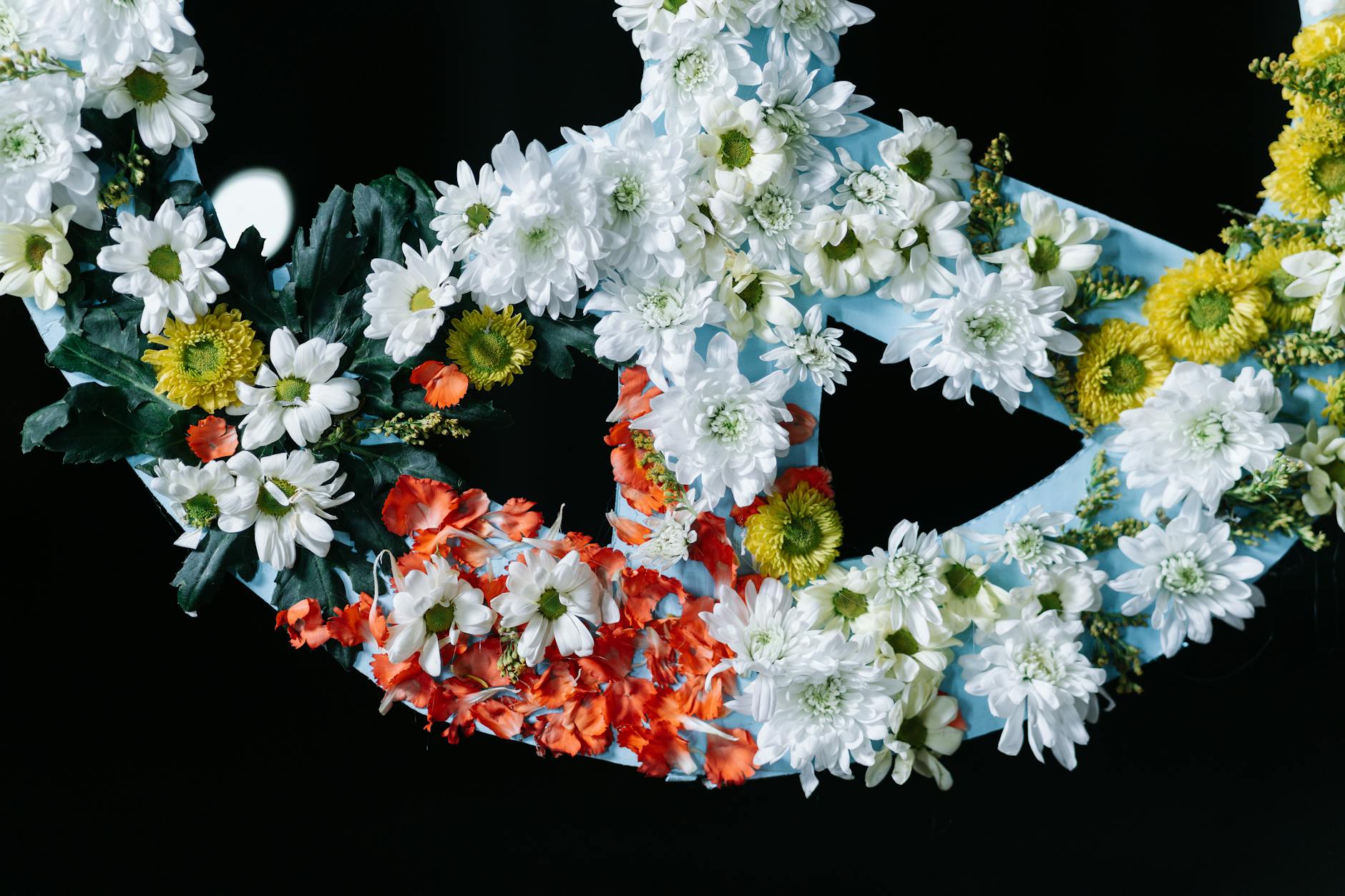
On Friday, October 11th the Norwegian Nobel Committee awarded the 2024 Nobel Peace Prize. The prize was bestowed upon Nihon Hidankyo, a Japanese group dedicated to eliminating nuclear weapons. This grassroots movement was founded by survivors of the 1945 bombings of Hiroshima and Nagasaki in Japan.
The survivors, known as Hibakusha, have used personal testimony to illustrate the destruction of nuclear weapons. Survivors include people in the area when the bombs were dropped, people who were present at testing sites, people who responded to the disasters and the children carried by pregnant women. It is estimated that a little over one hundred thousand survivors are still alive. Their testimony includes the horrors of the day and the following weeks. They speak of the illness that resulted, skin lesions and cancers. They speak of the families, communities and environment that was destroyed.
The work of the Nihon Hidankyo reminds us all what is possible. Their tireless efforts means that nuclear weapons have become regarded as too dangerous. Alfred Nobel believed that individuals could make a difference. We must remember that.
Read the press release from the Nobel Committee here.
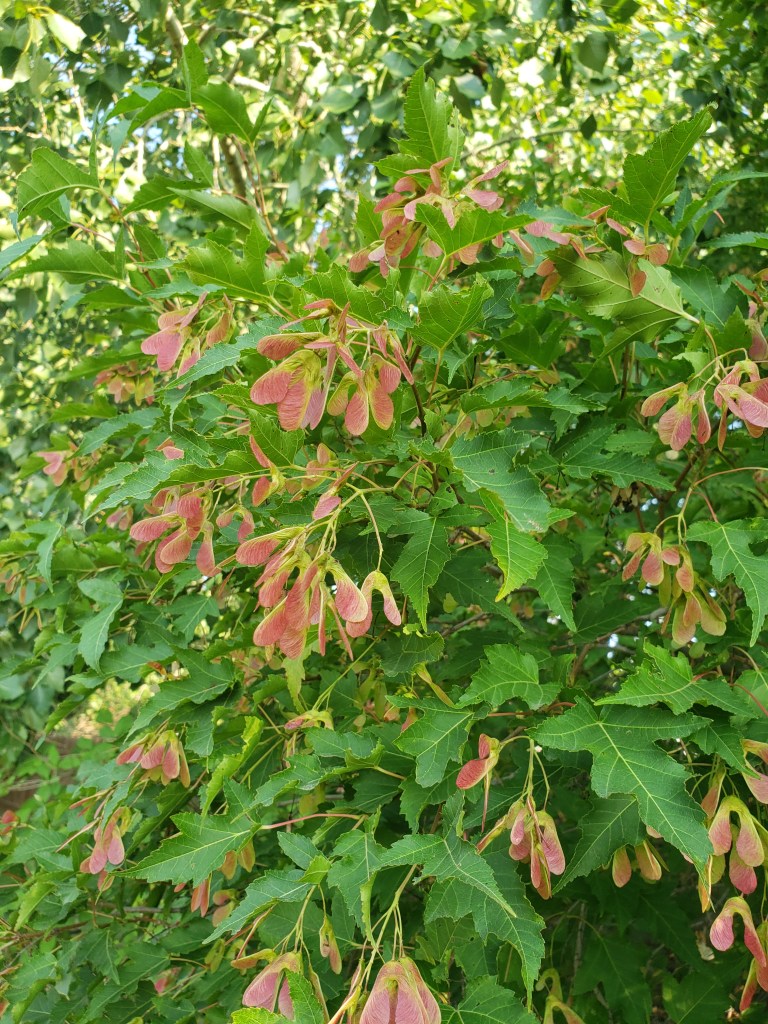
Colourful samaras on an Amur Maple. Photo: PeaceSignsPruners
The gardeners’ world has become like the fashion world: every season there are new releases, new ‘must-haves’, new colours and shapes! If you’re on social media the algorithm has picked up on your like for gardens and you are deluged with ads for the latest plants as well as influencer posts declaring their love for the new and nifty.
How do we get new plants? Well, there are a few ways. There is the time honoured tradition of exploration and discovery. It’s seems almost unbelievable but there are still places on this Earth where humans have rarely walked. The deepest corners of the Amazon, the heights of the Andes or the meadows of the Alps, to name a few, all hold plants never catalogued. You have to be a real plant nerd to keep up on these things. Here’s Kew Gardens’ list of the most exciting discoveries of 2023. A tree that grows underground? How fantastic!
Plant exploration and discovery does not hold the prestige it once did but there are still intrepid scientists out there. When the New World was still new to Europeans, fortunes could be made by introducing new plants. Have you heard of ‘Tulip Mania’ in the 1600’s? The tulip, introduced from Turkey, had some interesting and exotic varieties. Collectors went a little crazy and the price rose astronomically, fueling a financial collapse when prices finally bottomed out. Read more about it here. Or how about Victorian Fern Cases? When a glass box was designed to keep Amazonian species alive, collectors went a little crazy for ferns. You were nobody if you didn’t have a Fern Case with an exotic specimen. Read more about that here.
Another way that we get new plants is by selection. This has been used since ancient times, when the first farmers noticed a grain that produced better and saved seed from it for replanting. It can be applied to any plant. Imagine a family farm that grows a tree for the horticultural trade. They grow nothing but, say, Amur Maple (Acer tataricum subsp. ginnala), ten thousand of them in the field. The farmer notices that one tree has brighter samaras (seed pods), a more vibrant pink than most. It’s got a nice form and habit: straight trunk, not too large a canopy, good fall colour. This tree is different, it’s special with those bright seed pods. So the farm begins to propagate it from cuttings, to clone it and make exact replicas. And so, Amur Maple ‘Ruby Slippers’ was created. The document here states that the finders started propagating in 1991 and the tree was trademarked in 2004.
There is money to be made by selecting superior plants. Once patented a small fee will go to the farm for every sale. It can be big money when it’s a plant that can sell to a large audience. It is also a process that one has to invest time in, the plant must be cloned and the offspring must be watched to show that the DNA is consistent. The grower must allow the tree to become old enough to produce seed. Rushing to market can lead to professional embarrassment; anyone remember a variegated weigela released that refused to stay variegated? Once the shrub rooted in, all the branches it produced were plain green. The plain branches were much more vigorous than the variegated so one had to continually prune out the unwanted branches. This left a puny shrub that usually died.
We get new plants from breeding and crossbreeding. This is taking the pollen of one plant and applying it to the stamen of another, creating a hybrid. In the modern age this can also mean taking genes from one plant and inserting them in another. The point is to get the best qualities of both plants. This can be a long process; one must allow the offspring to develop, test them to see that they have the desired qualities and test again to see if the seed the offspring develops stays true. The processes began to be understood in the 1800’s, when Gregor Mendel starting working with peas.
Breeding plants can be very profitable. These plants can be patented and the breeder receives a royalty each time one is sold. It is a meticulous, painstaking process. There is always a goal: bigger blooms, better disease resistance, better leaf colour. All the crosses, all the parents, must be recorded and the outcome recorded. The new plants must be grown and observed. If the outcome is not achieved, the breeder must continue with more cross pollination, adding a different parent. And so on, until the goal is achieved.
Have you ever saved seed from your garden, planted it and got something totally unexpected? You might have bred a new variety and you could make a bunch of money!
Today’s a good day to move my houseplants up to a bigger size. It’s a good day because it is not super windy outside; the last three days we’ve had winds gusting to +50 kph (35 mph). I like to do re-potting outside to avoid making a mess in the house. I always seem to fumble a pot or miss with a scoop of potting mix.
Late summer is an excellent time to re-pot. The plants have had that burst of growth through the longer days of spring and summer. As the days shorten through the fall, the plants will slowly go dormant. If I re-pot now, they will have the time and energy to grow some roots in their new homes. I will only go up one size of pot, unless I find a plant very root bound.
A plant with too many roots will have difficulty picking up water and nutrients. The plant can continue to root in the shape of the pot, eventually strangling itself. The symptoms can look like under-watering, so it’s beneficial to pull the plant from the pot. Here’s some further info here. Somethings, cacti and succulents in particular, like to be a little root bound probably because it mimics their natural desert conditions.
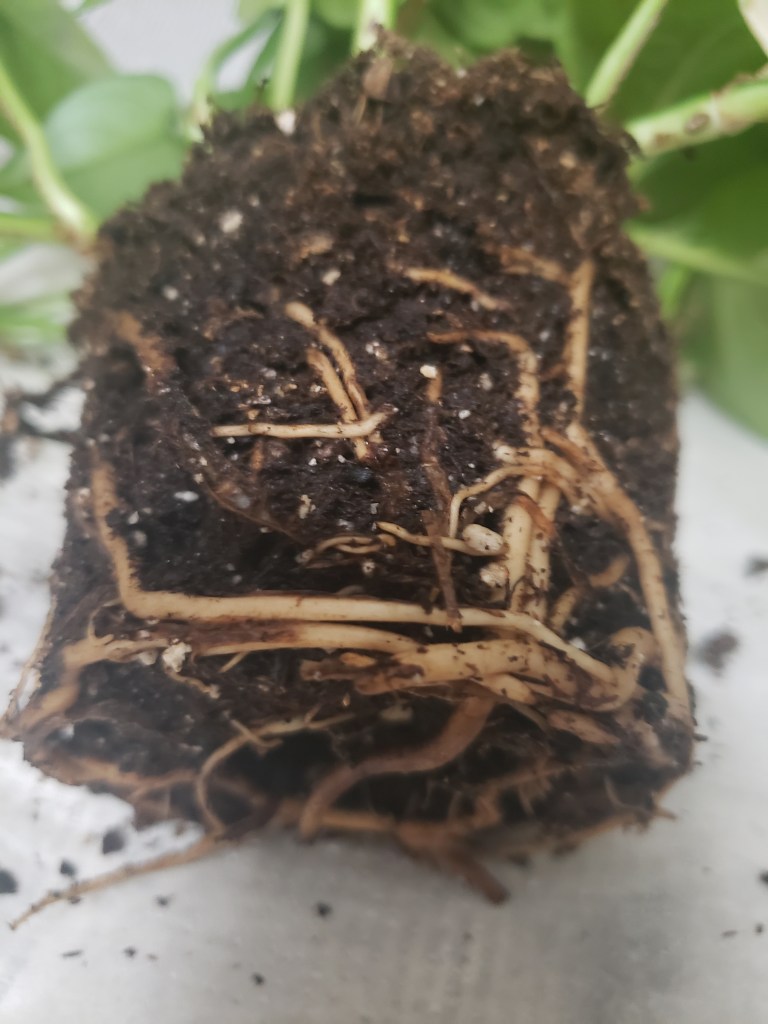
The golden Pothos pictured above has a healthy set of roots, just beginning to take the shape of the container. Notice that the roots are around the bottom of the pot? That’s because I bottom water. After a number of decades of caring for houseplants I accept that I am a chronic over-waterer of houseplants. I especially try to baby them in the long, dark days of winter. I kill them with kindness and the need to garden. Now, I rarely plant directly into an ornamental container, I plant into an appropriate sized plastic pot. I lift the plastic pot to check the weight of the pot; if it needs water I place it in a container of water covering the drainage holes and let it soak up what it needs before returning it to the ornamental pot.
The plant pictured above I only had to gently tease the roots apart, to keep them from continuing to grow around. Sometimes you may need to cut into the mass, sometimes you may be able to divide a plant into two or three pieces. Like pruning on the above ground parts, always remove dead/diseased/damaged and then you could remove up to a third of the root mass. You can re-plant in the original pot if you want, just remove enough root mass to fit into the pot.
You can always water in a rooting hormone, if you’d like the extra assurance that things will go well. It’s generally not necessary, the plants will not be dormant for a few months and should root well. You should be lessening your application of any kind of fertilizer now and quit fertilizing by the end of October. As always, allow to dry out a bit between waterings. I’m just going to use a basic bagged tropical plant soil without fertilizer.
I know we’re just enjoying this year’s bounty and beauty. Are you thinking about next year? Are you planning on saving any seeds? Patience is key in saving healthy seed. You may have a lovely little seed head now but is it mature and viable?
Consider that a seed is like an egg in a bird’s nest. The seed coat is the shell, inside is endosperm which is like yolk and there is an embryo or little spark of life. The egg, when laid by momma bird, does not have a baby bird…yet. The mother must sit on the egg to keep is warm for the embryo to develop.
So it is with plants. The seeds need to be attached to the mother plant for a little while to develop properly. Now it is a bit of a fine balance: critters and birds want to eat the seeds, wind wants to blow them to a new home. It is the yellow, soft cucumber that will have viable seed, not necessarily the small one you choose for eating.
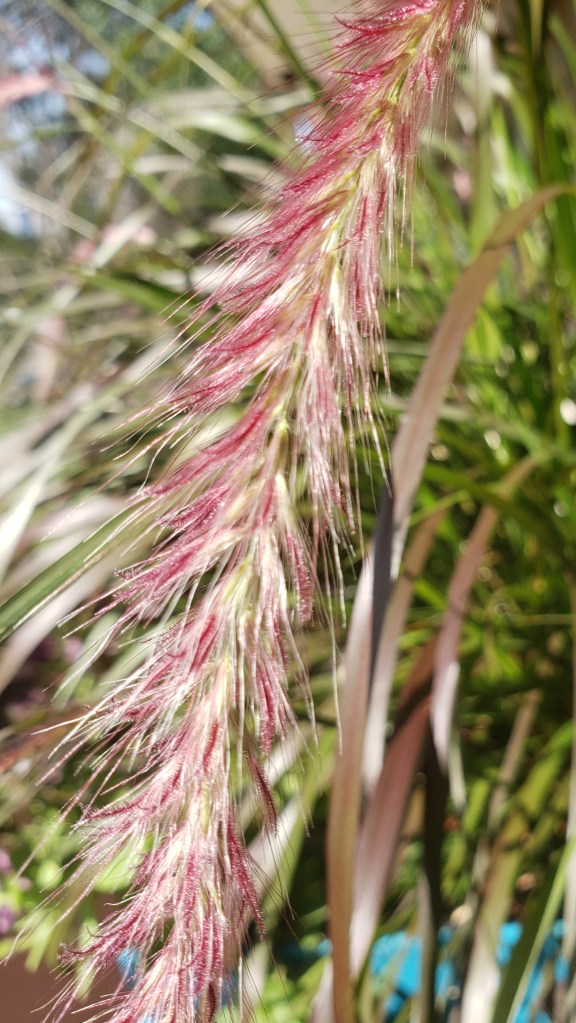
How can you tell? With peas, beans and flowers like milkweed the pod becomes brown and brittle. The ornamental grass pictured, purple fountain grass (Pennisetum) will get very beige and fluffy, then the small seeds will pull off quite easily. Most flowers develop a bulge right under where the flower petals were which will dry and eventually split, revealing the seed. Sunflowers hold their seeds in the centre head.
If you are anxious to save a certain seed perhaps protect it by wrapping the developing head or pod with something breathable: paper, muslin or horticultural fleece will work well. Staple or tie it around the seed head to secure. Do no use plastic wrap or bags; moisture can be trapped leading to mold or the sun on the bag can super heat the contents essentially frying what’s inside. Cut the stem and bring the seed inside once you think it’s mature.
We have to have a word here about what’s worth saving. Some seed will not be what you thought you were saving or the seed may be sterile. Seed must be pollinated to become viable. Yeah for the pollinators, we really need them! Plants can only be pollinated by those in their genus and often species; apple (Malus) cannot by pollinated by cherries (Prunus) even though they are both in the rose family. Squash are notorious for allowing pollination from their close cousins, so zucchini (Cucurbita pepo) can be pollinated by pumpkins (Cucurbita pepo) but not by butternut squash (Cucurbita moschata). The seeds you planted should only produce zucchini but the seeds you save could produce some odd cross-pollinated squash. If it’s tasty you can trademark it, name it and make a million dollars.
Some of your well loved plants are hybrids or F1 hybrids, meaning they are like the offspring of zucchini and pumpkin crosses. They can produce wonderful new additions to our gardens but they may not be what you want when you save their seed. Many of the modern petunias, for example, are hybrids; the seeds are either sterile or produce something you do not expect. If you’re really in love with one of those plants it is better to take cuttings (clones) soon and keep the plant like a houseplant through the winter.
Seed suppliers protect their stock by growing related plants far apart: separate fields or separate greenhouses. They may do fertilization by hand, then cover the flower or developing seed head to prevent other pollen from entering. As a homeowner with a small garden it’s impossible to segregate plants, even if you have some in the front yard and some in the backyard the pollinators can fly that far.
Did you know that spring blooming trees and shrubs will make their blooms the previous fall? Next springs’ bloomers make their buds on old wood, wood that grows this year. Through late summer and fall, they form the flower buds for next year. The blooms are tightly furled and protected by a hard bud case or shell.
To maximize next springs’ blooms do your pruning now. Once your shrubs and trees have finished blooming it is a good time to do any thinning, shaping or reduction in height. However, you need to get it done by mid-summer, to avoid taking any formed blooms. This is especially important for cold-climate gardeners, who have a smaller window of opportunity.
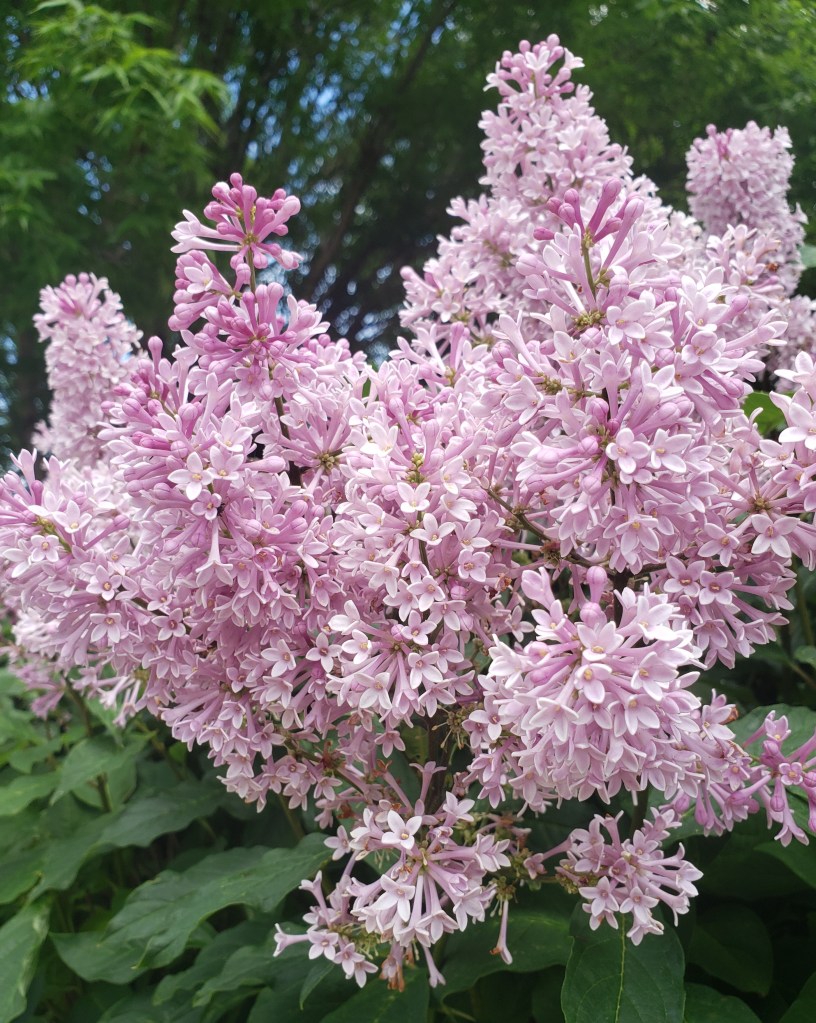
Hardy shrubs and trees that bloom on old wood include forsythia, lilacs, mockorange, purple sandcherry, ninebark, azaleas and rhododendrons, weigela, some spirea, some honeysuckles and most of our fruit trees and shrubs. When pruning fruit producing trees and shrubs be careful to not damage your current fruit!
Remembering when your plants bloom is one great reason for keeping a garden journal. If you have trouble remembering come fall here is a great chart from U of Colorado. The chart has plants we can’t grow on the Canadian Prairies but is helpful if you’re trying to push the boundaries or have a great microclimate. I grew a deutzia for many years, said to be hardy for Zone 4. I admittedly had a great microclimate, a sunny yard well protected on four sides by mature shelterbelt and the house.
As always, follow up pruning with some love and care. Water well in the drought of summer and add light balanced fertilizer or compost. While you’re out there, check the trunks of any of your trees and rub off any sprouts before they become branches!
 Peace Signs and Pruners