I have a new bad habit. It’s not doom scrolling, I call it life scrolling…
I adore these time lapse videos of seeds growing. I particularly like the ones in glass containers, like this carrot or the potatoes. Every little seed is just a miracle! Isn’t Mother Nature amazing!
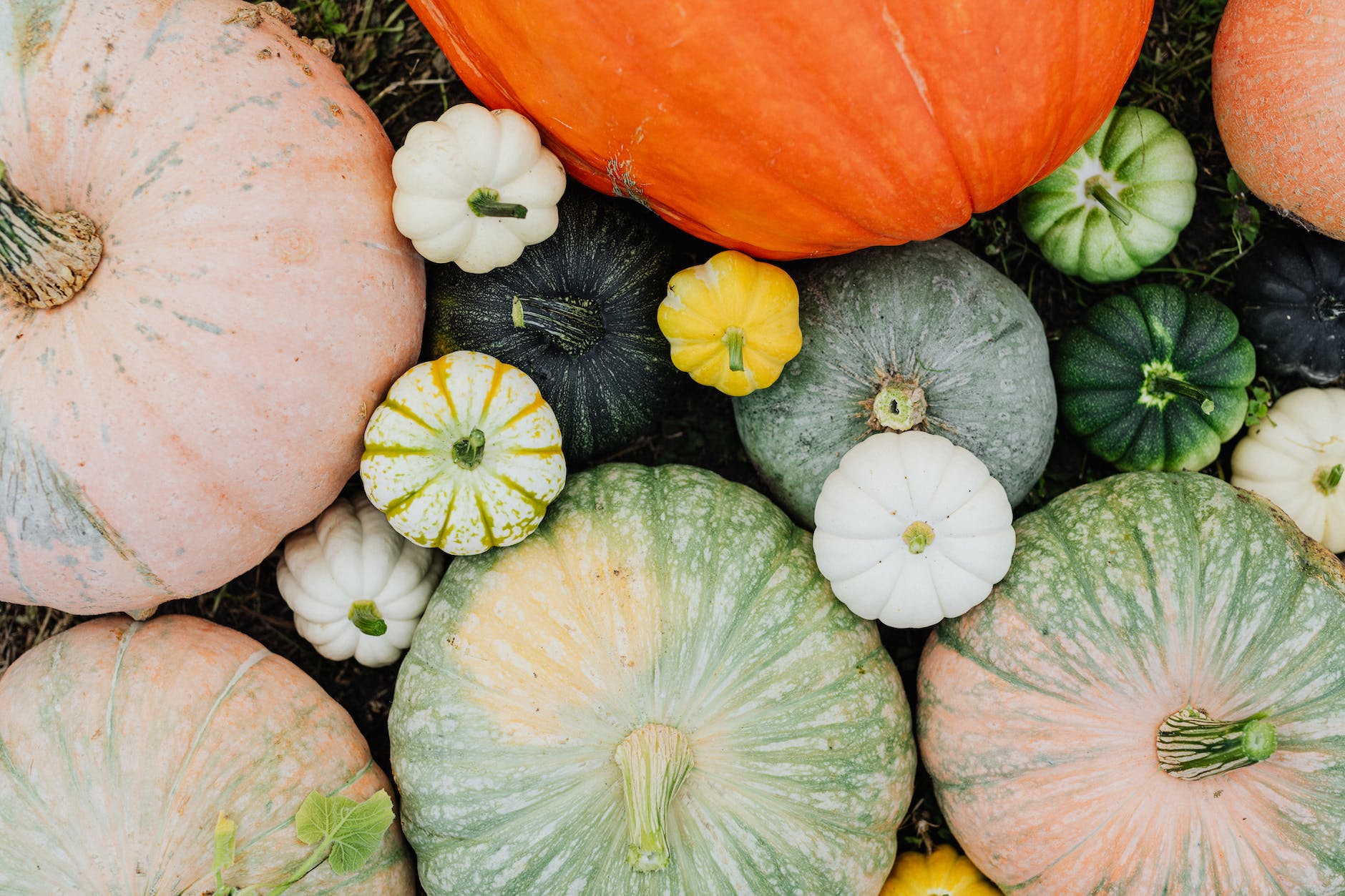
All pumpkins are edible. Some are just much better than others for eating. The pumpkin family (Cucurbita) is a winter squash, with a hard shell. Although the shell is often declared inedible I do know people that eat the the skin, once cooked. Pumpkins are related to all squash, gourds and cucumbers.
To keep things simple I consider pumpkins to be in one of two categories: edible and ornamental. If someone has grown the monster, prize-winning 700 pound pumpkin it is ediblish… it’s just kind of flavourless and the flesh is stringy. The little tiny, cute white ones? Not much meat ( called pulp) and also rather flavourless. Over the decades pumpkins have been bred or selected to fill one of those two categories.
If you wish to cook or bake with a pumpkin you should be looking for a sugar, pie or sweet pumpkin, not a Jack-o-Lantern or carving pumpkin. At the grocery store they are very rarely named; you’ll have better luck at a Farmers’ Market, where the growers will know what they planted. Pie pumpkins are sweet and the flesh is smooth and dense. Most pie pumpkins are small to medium sized. Look for ‘Sugar and Spice’, ‘Baby Bear’, ‘Sweet Sugar’, to name a few.
May I offer a few alternatives? When we were market gardeners, we grew over twenty winter squash. Many are inter-changeable in recipes. Butternut squash pie? Absolutely! Acorn squash muffins? Yum. Kabocha loaf, yes please! Still, some of my favorites are Jarrahdale, a blue-skinned heirloom that is also decorative until you’re ready to cook it. Long Island Cheese is a flat, pale peachy-beige skinned squash so sweet! Oh, and the Hubbards! Big, sometimes blue-skinned with sweet dense orange flesh; delightful eating. Check out this list here for some great eating, also check out all their recipes on Pumpkin Patches and More. Although don’t look for pumpkin patches there unless you’re in America.
Whatever kind of pumpkin you have, do save the seeds. Roasted pumpkin seeds are delicious and healthy snacking. Here’s the steps of the process here. Our chickens and goats loved them, too. You may find some claims that pumpkin seeds are an effective de-wormer for your critters, but do read this article first.
Pumpkins and all winter squash should store well in a cool (but frost free) place with low light. We’d wipe them all down with hydrogen peroxide to eliminate mold and fungus, we’d eat first any with blemishes and soft spots. We’ve eaten winter squash from our garden well into the New Year. And the variety that is possible is amazing: pasta sauce, soup, stew, risotto, muffins, cookies, cheesecake, bread and loaves. Check out this gallery of pumpkin recipes here from Delish Magazine.
We are a society that likes convenience. Instant gratification. Quick fixes. There is little, in the gardening world, as instantly gratifying as laying sod.
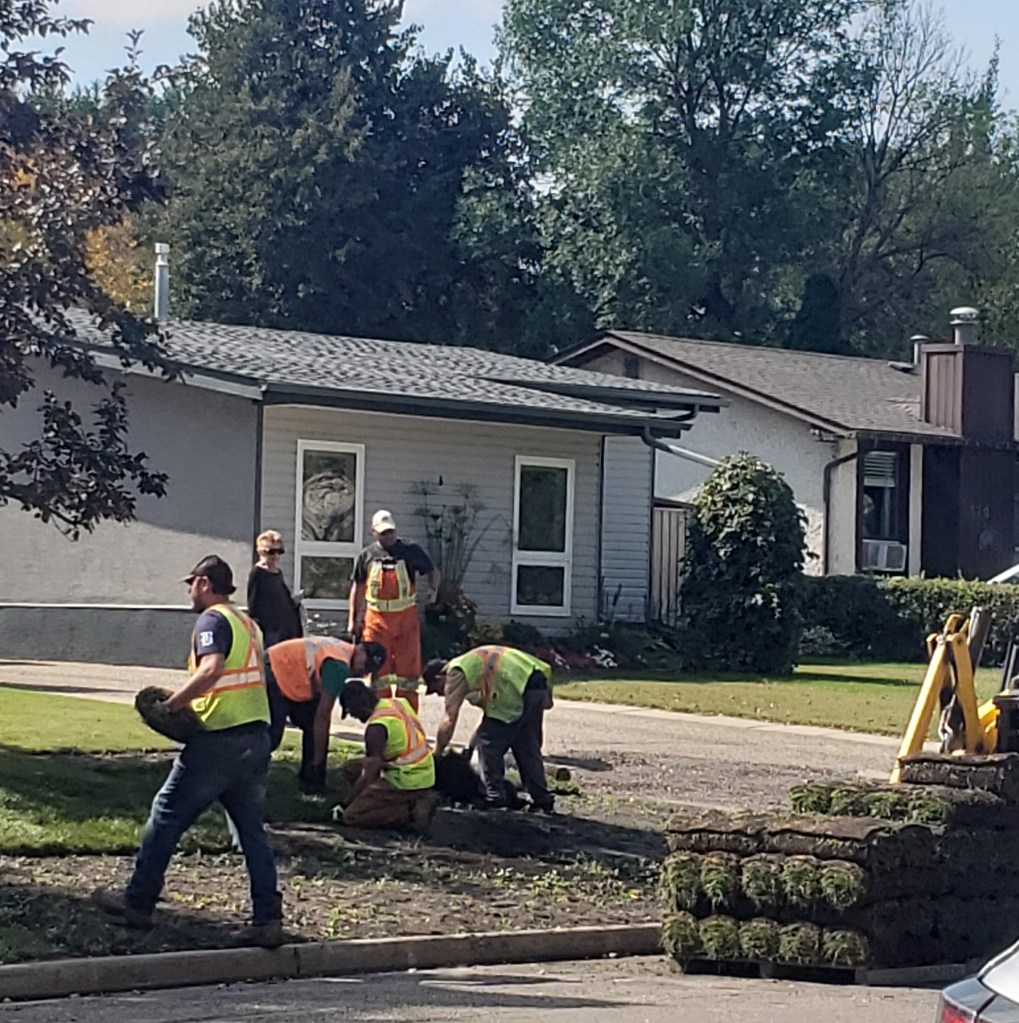
The people across the street had half their front lawn dug up by the city last year, due to water main issues. It sat that way for over a year, a big patch of gravelly soil. Finally, a few weeks ago, the city returned to finish the project. In ten minutes flat (with crew of five) a beautiful lawn appeared. Like magic!
There is still time, here on the Canadian Prairies, to seed a lawn or lay sod. Seeded lawn can take two weeks to a month to sprout. Then it’s patchy for a few weeks, then it starts to look like lawn. Sod? Instant! The preparation is the same for the two applications. Clean the area of rocks, clumps of weeds or soil, smooth the surface with a rake, improve the soil with a layer of compost, seed or sod.
Your local landscape supply or garden center will offer seed or sod appropriate to your area. Seeding is more cost effective, a bag of seed to cover an average front lawn would be around $20. Sod in this area is selling for $5-7 for a piece 2′ by 5′ (.61m by 1.5m). Laying sod can be a DIY project; it’s a great arm workout because healthy pieces can be a little heavy. The sod pieces are fitted like laying hardwood flooring and tamped down for a good fit to the soil. They are easy to cut with a box cutter or small saw so they can easily be worked around curved sidewalks or shrub borders. Then water, water, water. For more detailed instructions check out this post from The Spruce.
Sod is a perishable product so most often you must pre-order so that the supplier can bring in just what is needed. You would have a couple of days to get it installed while it is fresh. There are no returns. Occasionally you can get a deal if a landscape supplier has a bit too much on a Friday or Saturday as their own installation crews will not be working on a weekend.
It’s the Autumnal Equinox. At 2:50 AM EDT the Sun passed the equator and the Southern Hemisphere welcomes Spring. Here on the Canadian Prairies it has felt ‘fallish’ for a few weeks. The days are much shorter, we’ve had a few nights get as low as 2o Celsius (35oF.) with light frost in a few areas. Trees and shrubs are changing colour, leaves are already dropping, birds and butterflies have been gathering to migrate.
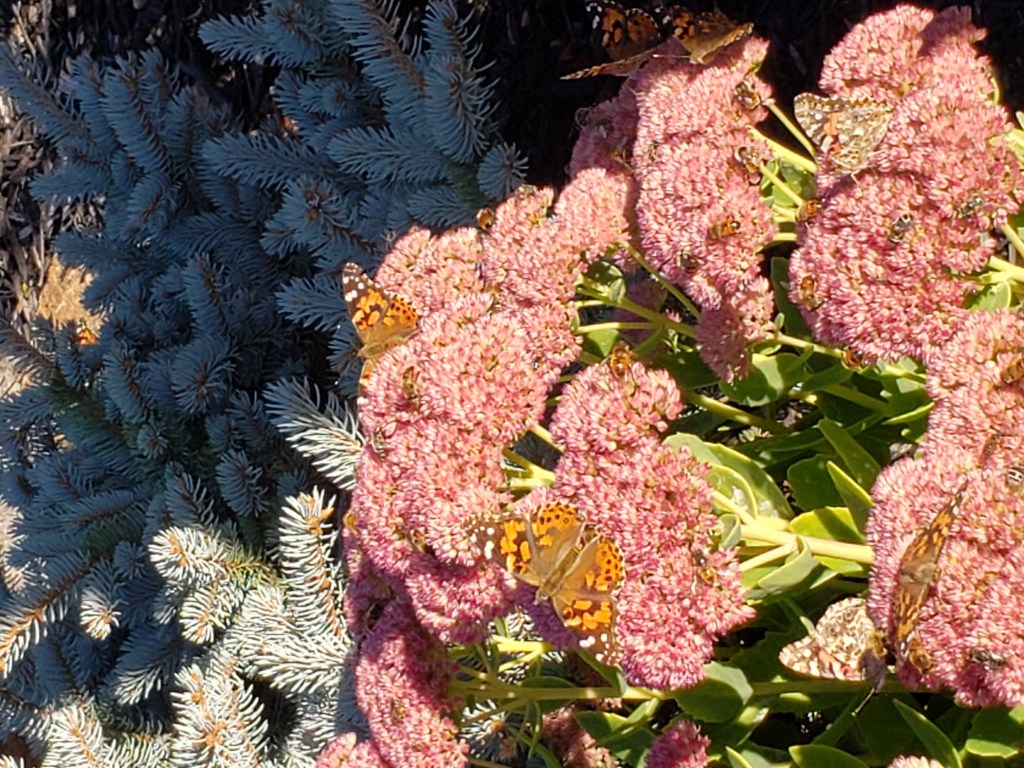
Sedum ‘Autumn Joy’ with Blue Spruce. Photo taken September 21, 2021. Note the Monarch Butterflies and Bees. Photo Author’s Own.
What does every Fall garden need? Fall blooming perennials. Those perennials that start blooming late, and can bloom right through light frosts, are a joy to have now. For Zone 3 gardeners look for hardy grasses, Mums (Chrysanthemums), Asters (Asters), Black-eyed Susan (Rudbeckia), Coneflower (Echinacea) and one of my favourites, Sedum.
If you have deadheaded summer blooming perennials you will likely get a second flush of flowers from such as Sage(Salvia), Russian Sage (Perovskia), Speedwell (Veronica) and even Bleeding Heart (Dicentra) may make a comeback as the weather cools. As plants are on sale at local garden centers, it’s a good time to indulge.
It’s not just the beauty of Fall colour; pollinators, other insects and birds really need this source of food. Monarch butterflies will feast on nectar before beginning their migration. Birds will fatten up on seedheads of grasses and flowers.
Get out the plaid clothes, grab a pumpkin latte or muffin and enjoy the Fall garden!
After posting yesterday on Fall being a great time to transplant, as well as plant, I came across this post of trees being harvested. I have never seen this type of machine; I am more familiar with tree spades, which take a much larger root ball.
I know these are young trees, maybe six to eight years old. I thought gardeners should see how little a root ball can be taken. I don’t know that I’d recommend quite this small a root ball, but if you do wish to transplant a tree or shrub this Fall, you can see that it does not need to be a massive effort! The exposed roots will probably be wrapped in burlap for transport, which is known as Ball and Burlap or B&B. The rows of trees in the video were probably tilled between the trees at least twice a year, to keep down weeds as well as to keep the trees from forming a wide root system.
If you’re transplanting trees or shrubs get the plant in its’ new home as soon as possible, then water well and continue to water until freeze up. It is critical (!) that the soil level on the plants is the same in the new place: do not bury trunks or stems. I would also highly recommend a root stimulant with mycorrhizal fungi. Read more of the science of this natural product here. It is really a great addition.
 Peace Signs and Pruners