Bee City Brandon in Manitoba has created a beautiful calendar for 2024. It’s a fundraiser for the re-wilding of Eleanor Kidd Garden, a treasure destroyed but flooding. Orders should be in by November 18th.
The calendar would be a great Christmas gift for so many people! First, it’s beautiful; the photography by local artist Cynthia Korman is stunning. Any nature lover would adore this. Any gardener interested in beautiful, hardy plants would love this, and learn new things all year! Anyone interested in helping pollinators would make good use of this. Anyone interested in native plants on the Prairies would value this calendar. Teachers could use it in the classroom.
The calendar is raising funds to rehabilitate the now derelict park. The City of Brandon has no funds available (think new bridge), and must consider the costs of investing in a park that may flood again in future years. That is why they invited Bee City Brandon to develop a pollinator-friendly, native garden that could be beautiful and withstand flooding.
The calendar is just one of the many ways Bee City Brandon is raising money. The committee has been applying for grants and working on other projects. The work will be almost entirely be done by volunteers so if you’re in Brandon, with fond memories of Eleanor Kidd Garden, sign up here to volunteer some weeding or planting new year. Hopefully I’ll see you there!
I don’t mean dull or uninteresting. I mean the types of bugs that burrow into your trees and cause damage. Every eco-system that has trees has some type of boring insect, usually the young stage of a beetle or weevil (Coleoptera). I don’t count termites in this group because, largely, they eat dead wood or lumber, not live trees. I’m sure Mother Nature considers the termite a good friend and an awesome recycler, breaking down fallen trees in the forest or jungle. Humans don’t appreciate them when they start to eat their way through the wooden infrastructure of our buildings, bridges and furniture.
Let’s look at our native poplar borer. The adults live for just a few months in early summer. They feed on tender new growth. The female will lay eggs in furrows in the bark. The eggs hatch and the babies burrow into the tree. They can live two to four years inside a tree! They eat xylem and phloem, disrupting the flow of water and nutrients through the tree. They can munch their way right through to the heartwood and seriously compromise a tree.
When diagnosing pests and diseases of trees and shrubs we’re looking for signs and symptoms. Signs that you have a pest include small holes in the trunk. In the case of poplar borer these are near the base or above the root flare, and may leak sap. There may be frass or sawdust at or under the hole. If woodpeckers are particularly interested in your trees you may have a boring insect. In the case of the bronze birch borer, the holes are a distinctive ‘D’ shape and are higher, usually between a human’s knee and shoulder. Symptoms of borers include die back of the top growth or side branches, swelling under the bark or sap leaking.
Generally, our native boring insects are not a huge problem. They are part of an eco-system, they have their good years and their bad years. They have their own predators, diseases and stresses. Late frost can kill the emerging adults. Woodpeckers and nematodes can attack them, they have their own parasites and fungal diseases. Research has shown that a healthy tree is less prone to borer attacks. Some years ago the paper birch (Betula) became very popular as a landscape tree here on the Prairies. Natively, the paper birch is found in moist areas along streams, lakes, boggy areas. Homeowners bought them, plunked them in the middle of a suburban lawn and ignored them. The trees were stressed, thirsty and were attacked by bronze birch borers. Keeping your trees healthy is half the battle; choosing the right tree is the other half.
Twenty years ago we had a class of pesticides known as systemics. These were chemicals that, to simplify, were absorbed by the woody plant, became part of the plant and bugs that ate that plant died. It was really the only way to deal with pests protected by being inside the tree. Most systemics were removed from sale to residential users in Canada for being too toxic to humans, to the birds and the bees, and to aquatic creatures. Anyone remember Cygon 2-E? I am watching, with interest, the Canadian Forest Service developing a systemic from the Neem tree called TreeAzin.
When boring insects become a huge problem is when they are not native. They have no predators, no diseases and trees do not have a natural resistance. A recent example of a disastrous introduction is the accidental importation of the Emerald Ash Borer into North America. In it’s native Siberia, northern Russia and north Asia the beetle have predators such as parasitizing wasps. Native birds will eat the adults, but here the birds didn’t know what to make of them. The loss in mature ash trees is estimated in millions of trees and billions of dollars. Read more about it here. Another case is the disease Dutch Elm Disease, when a the Elm Bark Beetle was introduced. The beetles carried a fungus which devastated the majestic elms. Read more about it here. The loss of millions of shade trees results in loss of habitat, loss of shade and cooling, loss of windbreak.
So what’s the homeowner to do? First and foremost, keep your trees healthy. Fertilize or amend your soil in spring, water well during times of drought. Examine your trees in Spring and Fall looking for signs and symptoms. Check the websites of your local extension service, local university or government body responsible for forests and agriculture (in Canada to Natural Resources Canada) to stay apprised of problems. Because isn’t your glorious shade tree worth a little effort?
Are you uptight about climate change? Are worries keeping you up at night, or invading your dreams? You are not alone. According to Statista.com 74% of Canadians are worried about global warming. A poll in April 2021 showed 80% of respondents considered climate change a present danger.
Wikipedia defines eco-anxiety as ‘chronic fear of environmental doom’. The term seems to have been coined by philosopher Glenn Albrecht in 2011, yes that far back. The attention to the problem increased around 2018 when Greta Thunberg discussed her own issues in the media. In 2018 the American Psychological Association issued its’ first report on the topic.
The symptoms can be many. Obsessive thoughts, existential dread, guilt, anger and frustration toward authorities, depression, anxiety, panic, sadness, trouble sleeping. Solastalgia is a yearning for the way your area, neighbourhood or country used to be. It’s a term that was first used, again by Glenn Albrecht, in articles in 2003 in the wake of ecological disasters such as mining accidents.
Research indicates Gen Z and Millenials are most affected. They are the people who have had the greatest access to the internet since a young age. The way the algorithms work on social media, if you stop to look at one disaster posting you will be shown more. Doomscrolling is a vicious cycle of seeing more and more bad ‘things’.
I don’t have a cure but I can offer an antidote. You need, in your inbox and on your social media sites, more good environmental news! Every day! There are many people out there in the world inventing new solutions, taking action, making a difference. You need to hear about it more.
Find Sam Bentley on almost any social media site or on his website. Nothing but good news for the environment and his British accent is lovely. On Tik Tok find @acorn_land-labs for sustainable solutions. As you may know, from this post here, I get a lift from watching groups getting out there to clean rivers and oceans. Find Sungai Watch, The Ocean Cleanup or 4ocean. A fellow that gets out and ‘tidies nature’ is Josh ‘Earthdrop’ Donaldson. Another lovely accent and beautiful music. I get a newsletter a couple of time a week from The Cool Down that is always full of interesting developments. And how about Re-Wilding Magazine; it comes into my inbox once every couple off weeks with stories about restoring Mother Nature.
There’s lots of great things happening; you just have to search out that news. Hopefully, it will make you feel better about what’s going on.
We are a society that likes convenience. Instant gratification. Quick fixes. There is little, in the gardening world, as instantly gratifying as laying sod.
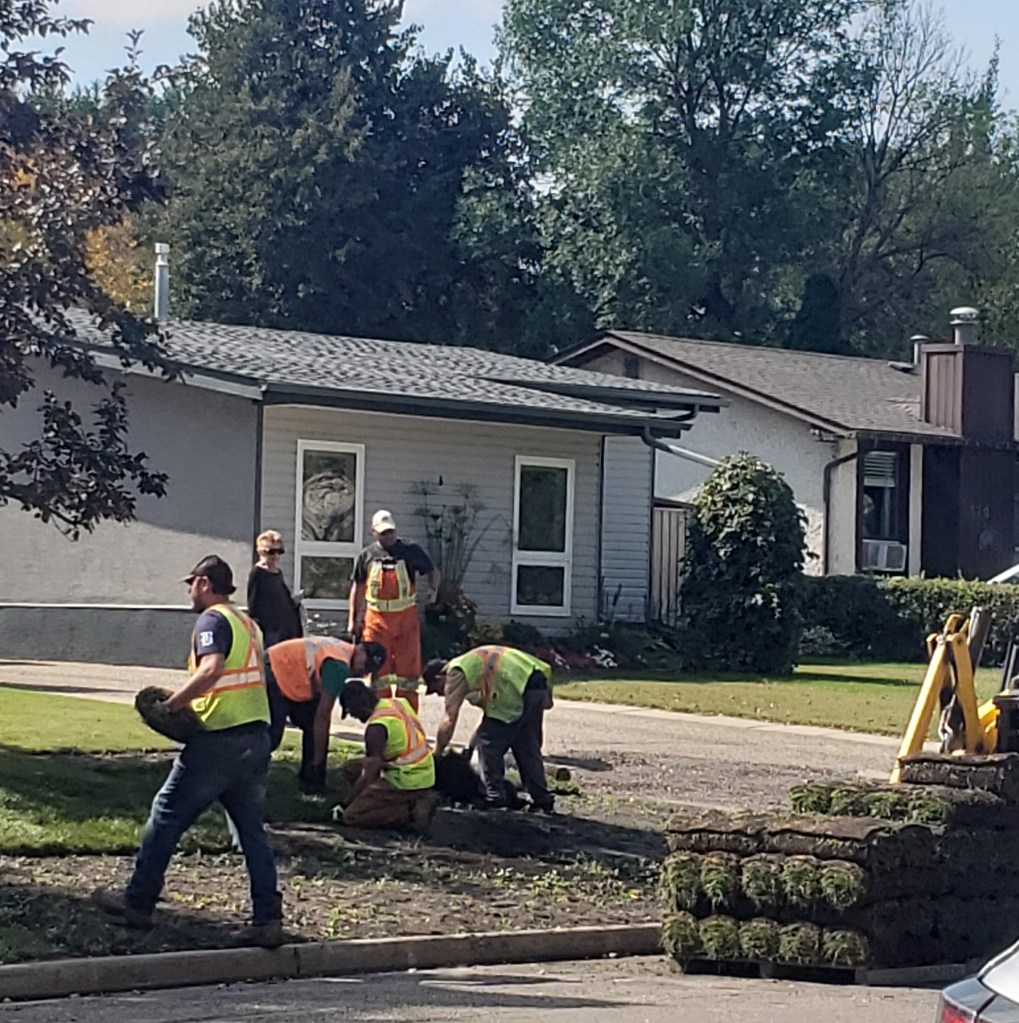
The people across the street had half their front lawn dug up by the city last year, due to water main issues. It sat that way for over a year, a big patch of gravelly soil. Finally, a few weeks ago, the city returned to finish the project. In ten minutes flat (with crew of five) a beautiful lawn appeared. Like magic!
There is still time, here on the Canadian Prairies, to seed a lawn or lay sod. Seeded lawn can take two weeks to a month to sprout. Then it’s patchy for a few weeks, then it starts to look like lawn. Sod? Instant! The preparation is the same for the two applications. Clean the area of rocks, clumps of weeds or soil, smooth the surface with a rake, improve the soil with a layer of compost, seed or sod.
Your local landscape supply or garden center will offer seed or sod appropriate to your area. Seeding is more cost effective, a bag of seed to cover an average front lawn would be around $20. Sod in this area is selling for $5-7 for a piece 2′ by 5′ (.61m by 1.5m). Laying sod can be a DIY project; it’s a great arm workout because healthy pieces can be a little heavy. The sod pieces are fitted like laying hardwood flooring and tamped down for a good fit to the soil. They are easy to cut with a box cutter or small saw so they can easily be worked around curved sidewalks or shrub borders. Then water, water, water. For more detailed instructions check out this post from The Spruce.
Sod is a perishable product so most often you must pre-order so that the supplier can bring in just what is needed. You would have a couple of days to get it installed while it is fresh. There are no returns. Occasionally you can get a deal if a landscape supplier has a bit too much on a Friday or Saturday as their own installation crews will not be working on a weekend.
It’s the Autumnal Equinox. At 2:50 AM EDT the Sun passed the equator and the Southern Hemisphere welcomes Spring. Here on the Canadian Prairies it has felt ‘fallish’ for a few weeks. The days are much shorter, we’ve had a few nights get as low as 2o Celsius (35oF.) with light frost in a few areas. Trees and shrubs are changing colour, leaves are already dropping, birds and butterflies have been gathering to migrate.
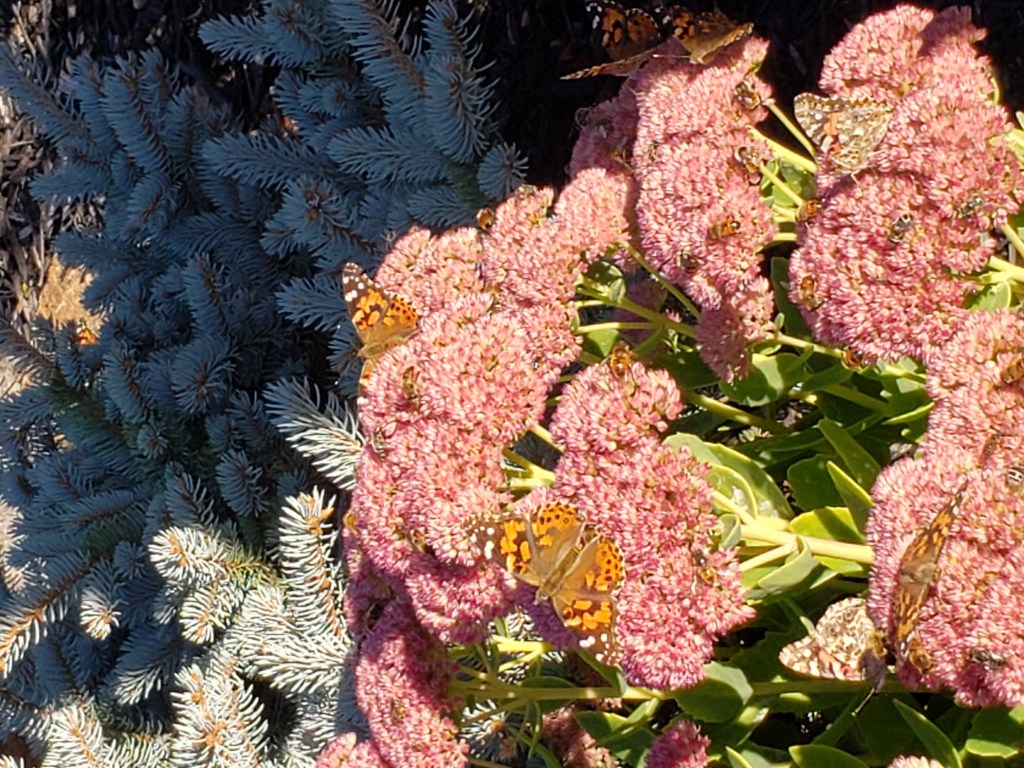
Sedum ‘Autumn Joy’ with Blue Spruce. Photo taken September 21, 2021. Note the Monarch Butterflies and Bees. Photo Author’s Own.
What does every Fall garden need? Fall blooming perennials. Those perennials that start blooming late, and can bloom right through light frosts, are a joy to have now. For Zone 3 gardeners look for hardy grasses, Mums (Chrysanthemums), Asters (Asters), Black-eyed Susan (Rudbeckia), Coneflower (Echinacea) and one of my favourites, Sedum.
If you have deadheaded summer blooming perennials you will likely get a second flush of flowers from such as Sage(Salvia), Russian Sage (Perovskia), Speedwell (Veronica) and even Bleeding Heart (Dicentra) may make a comeback as the weather cools. As plants are on sale at local garden centers, it’s a good time to indulge.
It’s not just the beauty of Fall colour; pollinators, other insects and birds really need this source of food. Monarch butterflies will feast on nectar before beginning their migration. Birds will fatten up on seedheads of grasses and flowers.
Get out the plaid clothes, grab a pumpkin latte or muffin and enjoy the Fall garden!

 Peace Signs and Pruners