
If you are at all interested in the natural world you need to be familiar with botanical Latin. Whether you are a gardener, a houseplant buyer, someone who watches birds or other creatures, a forager or a native plant enthusiast a foundation in Latin will serve you well. Not only will you be able to name exactly the creature or plant you are viewing, but you will also be able to determine some of its’ characteristics from the proper name.
For example: the common name of a popular perennial plant here in Manitoba is coneflower. Depending where you are, however, coneflower might mean a Dracopsis, Echinacea, Rudbeckia, Ratibida or Isopogon. If you want the coneflower that will make you a natural medicine that (purportedly) guards against colds and flu you want Echinacea angustifolia or E. purpurea. If you unwittingly order Echinacea tennesseensis you would end up with a plant not hardy for the Prairies and wanting quite a moist location.
Taking you back to high school biology, all living things are divided into six categories or Kingdoms: Animal, Plant, Fungi, Protista, Eubacteria and Archaebacteria. The categories are further divided into Phylum, Class, Order, Family, Genus and Species. Remember? As hobbyists we are interested in Genus and Species and sometimes Family, the full listing is for scientists. Each division groups plants by commonalities, the ultimate name usually based on the flowers and the sexual parts. The farther you go through the list, the more specific you are.
Let’s look at the Rose Family: Rosaceae. The much loved rose bush (Rosa) is, of course, in the family. Included also are many of our fruit trees: apples, cherries, raspberries, almonds, peaches, pears, apricots to name a few. Also included are ornamentals such as potentilla, ninebarks, spirea, cotoneaster to name just a few. One feature they have in common is five petals in the flowers.
The use of Latin for plant classification is centuries old, as the first ‘scientists’, such as Greeks, Persians or Phoenicians, had their writings translated to Roman Latin once Rome dominated the ancient world. Latin continued for centuries, right through the Middle Ages, the Renaissance and to the Age of Enlightenment, to be the language of the educated elite. In the frenzy of European plant hunting, as Africa, India then the Americas were explored, the naming of discovered plants and animals was chaotic. The adventurers had a habit of naming things after themselves or their patron or their monarch. Carl Linnaeus is attributed with organizing Latin nomenclature in 1750’s AD. Take a deeper dive into the history of botanical naming here.
Let’s look at cats, for illustration purposes. All cats belong to the Family Felidae. There are fourteen Genera include Acinonyx (cheetah), Caracal, Felis (the common housecat and others), Leopardus (Pampas cats, ocelots, margay), Lynx (lynx and bobcats) and Panthera (lions, jaguars, leopards, tigers). A lion is Panthera leo while a jaguar is Panthera onca.
Have you noticed anything about how I write Latin names? The correct form is that italics are used to indicate all Latin words. The divisions from Kingdom to Family and Genus are capitalized, the species is in lower case. I must confess to being a bit snobbish about the use of Latin names: if they are used incorrectly in an article I assume the writer doesn’t really know their stuff or the article was AI generated with the bot not being trained on horticulture works. Either way, I usually don’t finish reading.
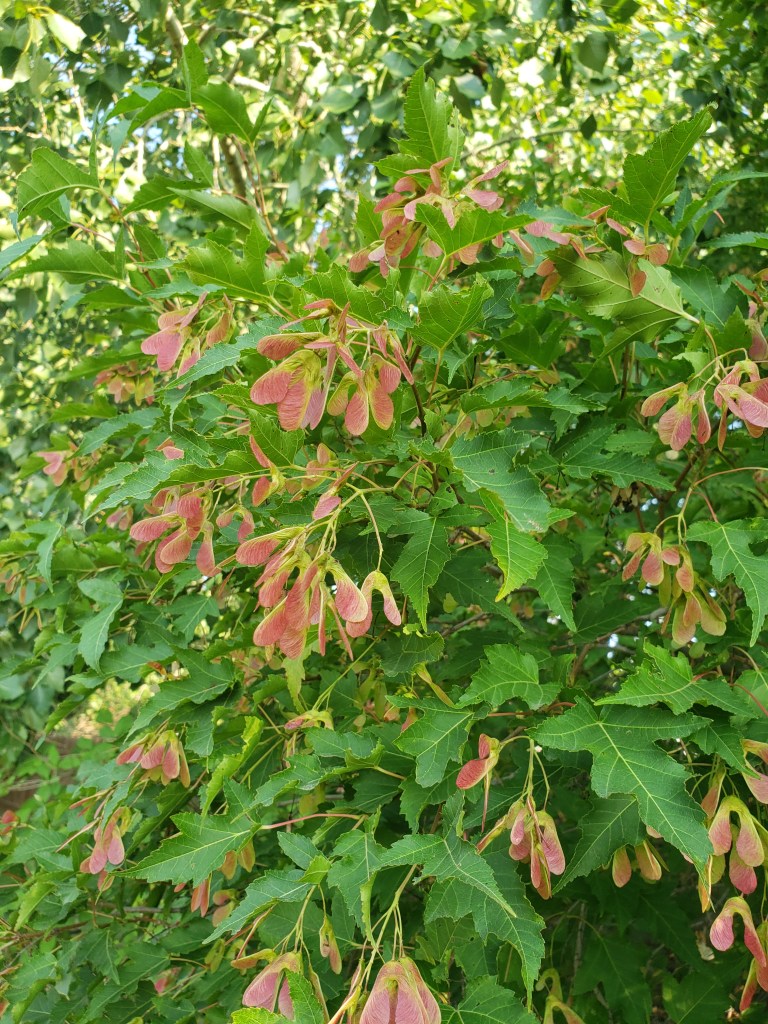
There are other forms you should be aware of in Latin names. A plant may be listed as a subspecies: Primula vulgaris subsp. sibthorpis is a version of common primrose that is just a little different from the rest of the species, but nonetheless a common primrose. Hebe x franciscana is a hybrid between two species. Acer ginnala ‘Ruby Slippers”, as mentioned in a previous post, is a selected variety with stronger characteristics than the regular Amur maple.
My go-to reference for botanical Latin for years has been ‘Botanical Latin’ by William Stearns. It seems to be out of print but I do also like this book, which a friend has. One reason to have a reference is that the species name can sometimes give you insight into the plant you are researching. ‘Alba’ means white, ‘microphylla’ means small-leaved, there is something to be learned from the plant name. Oh yes, be warned: botanists freely change the Latin names of plants as they discover more about them!

 Peace Signs and Pruners