The gardeners’ world has become like the fashion world: every season there are new releases, new ‘must-haves’, new colours and shapes! If you’re on social media the algorithm has picked up on your like for gardens and you are deluged with ads for the latest plants as well as influencer posts declaring their love for the new and nifty.
How do we get new plants? Well, there are a few ways. There is the time honoured tradition of exploration and discovery. It’s seems almost unbelievable but there are still places on this Earth where humans have rarely walked. The deepest corners of the Amazon, the heights of the Andes or the meadows of the Alps, to name a few, all hold plants never catalogued. You have to be a real plant nerd to keep up on these things. Here’s Kew Gardens’ list of the most exciting discoveries of 2023. A tree that grows underground? How fantastic!
Plant exploration and discovery does not hold the prestige it once did but there are still intrepid scientists out there. When the New World was still new to Europeans, fortunes could be made by introducing new plants. Have you heard of ‘Tulip Mania’ in the 1600’s? The tulip, introduced from Turkey, had some interesting and exotic varieties. Collectors went a little crazy and the price rose astronomically, fueling a financial collapse when prices finally bottomed out. Read more about it here. Or how about Victorian Fern Cases? When a glass box was designed to keep Amazonian species alive, collectors went a little crazy for ferns. You were nobody if you didn’t have a Fern Case with an exotic specimen. Read more about that here.
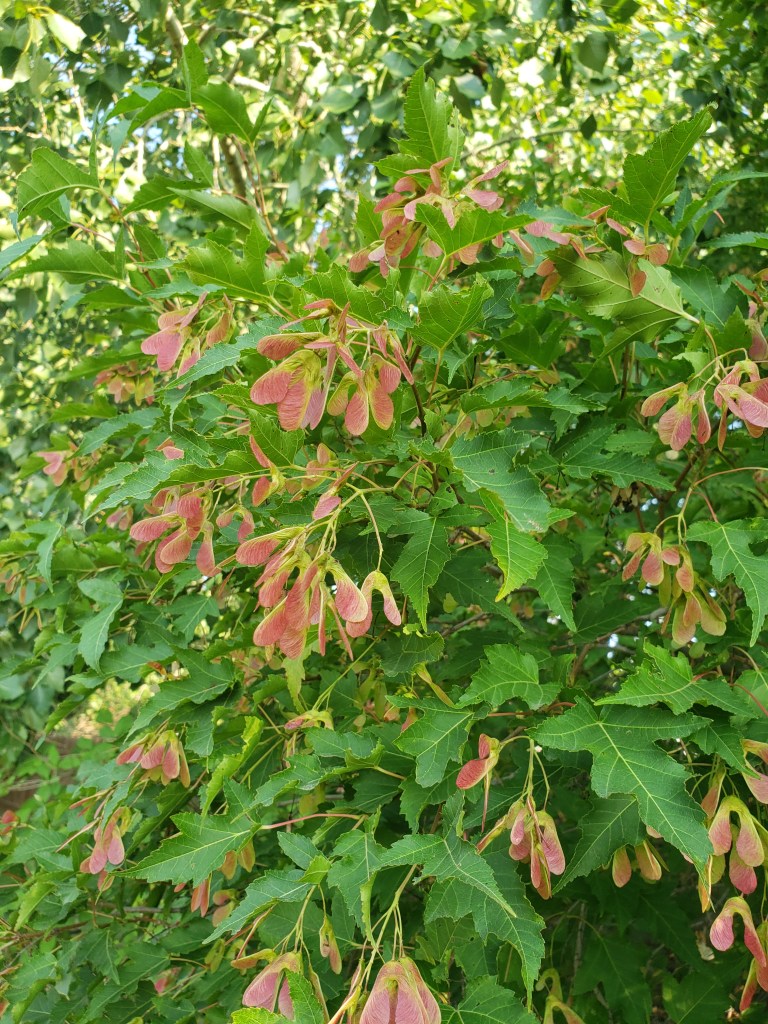
Another way that we get new plants is by selection. This has been used since ancient times, when the first farmers noticed a grain that produced better and saved seed from it for replanting. It can be applied to any plant. Imagine a family farm that grows a tree for the horticultural trade. They grow nothing but, say, Amur Maple (Acer tataricum subsp. ginnala), ten thousand of them in the field. The farmer notices that one tree has brighter samaras (seed pods), a more vibrant pink than most. It’s got a nice form and habit: straight trunk, not too large a canopy, good fall colour. This tree is different, it’s special with those bright seed pods. So the farm begins to propagate it from cuttings, to clone it and make exact replicas. And so, Amur Maple ‘Ruby Slippers’ was created. The document here states that the finders started propagating in 1991 and the tree was trademarked in 2004.
There is money to be made by selecting superior plants. Once patented a small fee will go to the farm for every sale. It can be big money when it’s a plant that can sell to a large audience. It is also a process that one has to invest time in, the plant must be cloned and the offspring must be watched to show that the DNA is consistent. The grower must allow the tree to become old enough to produce seed. Rushing to market can lead to professional embarrassment; anyone remember a variegated weigela released that refused to stay variegated? Once the shrub rooted in, all the branches it produced were plain green. The plain branches were much more vigorous than the variegated so one had to continually prune out the unwanted branches. This left a puny shrub that usually died.
We get new plants from breeding and crossbreeding. This is taking the pollen of one plant and applying it to the stamen of another, creating a hybrid. In the modern age this can also mean taking genes from one plant and inserting them in another. The point is to get the best qualities of both plants. This can be a long process; one must allow the offspring to develop, test them to see that they have the desired qualities and test again to see if the seed the offspring develops stays true. The processes began to be understood in the 1800’s, when Gregor Mendel starting working with peas.
Breeding plants can be very profitable. These plants can be patented and the breeder receives a royalty each time one is sold. It is a meticulous, painstaking process. There is always a goal: bigger blooms, better disease resistance, better leaf colour. All the crosses, all the parents, must be recorded and the outcome recorded. The new plants must be grown and observed. If the outcome is not achieved, the breeder must continue with more cross pollination, adding a different parent. And so on, until the goal is achieved.
Have you ever saved seed from your garden, planted it and got something totally unexpected? You might have bred a new variety and you could make a bunch of money!


 Peace Signs and Pruners