• Why Odd Numbers?

    September 10, 2024
    Design, DIY, Gardening, Landscape, Plants, Uncategorized
    Photo by Dmitry Zvolskiy on Pexels.com

    Clients would often approach me in the garden centre asking for help to find a “couple of shrubs”. Instead of asking what kind of shrub, I generally would always ask where they were putting the shrubs and what else was in the bed. I can get a lot of information from those answers, that will enable me to find the best shrubs for my customer.

    If they would be planting on the east side of the house, we’re looking for something part sun, at best. South side, without shade, something that can take it hot and dry. Out on a long drive way exposed to all types of weather, we need something tough as nails and hardy. If the customer stated that they had just dug a new bed in the corner of a fence now I have to explain to them why I really want to sell them three things, not two.

    The purpose of landscape design is ultimately to please and amuse the eye. Yes, we address concerns of functionality such as privacy, paths or drainage problems. Designers address form in terms of food gardens and wildlife habitat. The end game in all of the designing is something that is appealing to view. Things in odd numbers are more interesting to look at.

    Think of a pair of evergreens surrounding the front door. The two ‘sentinels’ are easily dismissed by the eye and the viewer notices the door instead. The pair (two) even if they are different plants is not challenging to the eye, it is overlooked, although it does formalize the entry way. Things in odd numbers makes the eye move from the first item, to the second and on to the third to take it all in. There is more interest; some call it tension.

    The ‘Rule of Thirds’ is not new and is not exclusive to garden design. Artists have been using it for centuries to create paintings that are more dynamic. Read more about the use in art and photography here. Interior designers use it in everything from furniture layout to creating vignettes on mantles and tabletops. Read more about that here. It is not just ‘three’ it is odd numbers. One, three, five, seven, you get the idea. That’s why a single shade tree, in its’ own bed, works. Consider the recipe for container planting; the saying is you need a thriller, a spiller and a filler…three things.

    For my client looking for a couple of shrubs, there are a few possibilities. The three things do not necessarily have to all be shrubs, the third thing could be a perennial, a boulder, a pot with annuals or a statue. We just need to achieve that tension to make a garden bed that is more interesting to view. Now I think you should go view your garden beds that you may find boring and start counting! Maybe even take another look at some of the groupings inside your home.
    1 comment on Why Odd Numbers?
  • Annual Containers Skewed?

    September 5, 2024
    Design, Gardening, Landscape, Plants

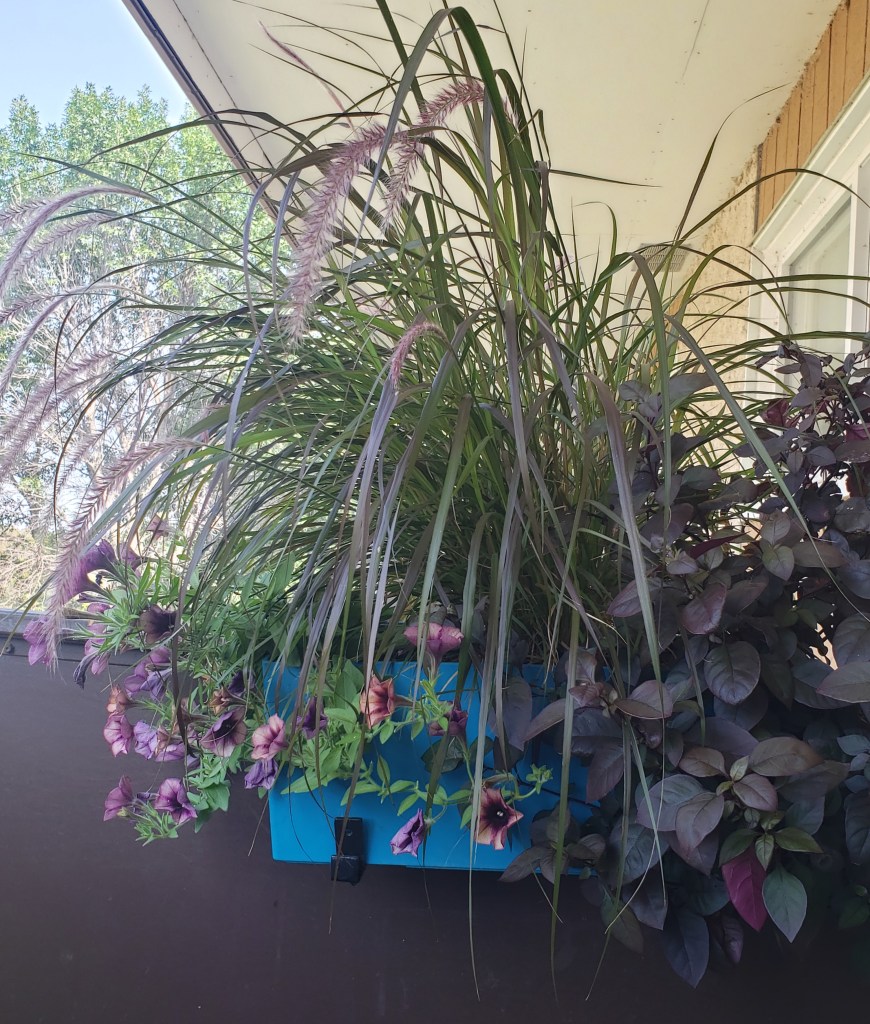
    Can you see it, in the picture? Everything is leaning to the left, just a bit. The petunia flowers are all facing to the left, the flowers of the grass and even the leaves are mostly on the left half. Even the Alternanthera, the dark leaf on the right, has it’s growing tips heading to the left. Which is to the west, where all the the sunlight comes from for a few hours every afternoon.

    Plants grow toward the sun, to maximize how many rays they can catch in a day. It’s a phenomenon known as phototropism. Have you ever grown sunflowers? The flowerheads literally follow the sun, moving from east in the morning to facing the west in the evening. Hmm, they must move during the night to face back to the east. Once the seeds are set and heavy the flowers only face the east.

    You must have seen phototropism in houseplants and particularly office plants. Many offices have very little natural light; I’ve seen plants growing almost sideways to reach the best source of light. The best source of light is often the fluorescent lighting overhead, although it’s not a full enough spectrum to encourage flowering.

    I could have balanced out my window boxed by flipping the container every week. However, it’s heavy and awkward and I don’t really mind it. It’s an annual planting to provide beauty as well as some privacy from the balcony down the way. It serves its’ purpose well. It will expire due to frost in the next six to twelve weeks, when we will not be on the balcony as much.

    I am always rotating my houseplants. Those I want a little more balanced. Every time I water I rotate them one quarter of a turn. If I had an annual planting in a round pot on the ground there would really be two options. I could plant the tall thing, the grass, at the very, very back of the pot, the Alternanthera in the middle and the petunias in the front. I wouldn’t really mind if the grass is leaning over the other two. It’s a good planting for a corner. If the pot is going to be seen from all sides I would do the grass in the middle, the other two plants on the sides. This container recipe I would make an effort to turn toward the sun weekly, so it grows in evenly. Some of the grasses’ flowers would be leaning over all around, the two other plants would grow out as well as expanding to the side.

    Hanging baskets not rotated are probably cascading over on side, these too can be flipped for more balanced growth. If you take a peek at your annual containers, or even your houseplants, is a little rotation in order?

    No comments on Annual Containers Skewed?
  • Time To Pot Up Houseplants

    September 1, 2024
    Environment, Gardening, Plants, Pruning, Transplanting

    Today’s a good day to move my houseplants up to a bigger size. It’s a good day because it is not super windy outside; the last three days we’ve had winds gusting to +50 kph (35 mph). I like to do re-potting outside to avoid making a mess in the house. I always seem to fumble a pot or miss with a scoop of potting mix.

    Late summer is an excellent time to re-pot. The plants have had that burst of growth through the longer days of spring and summer. As the days shorten through the fall, the plants will slowly go dormant. If I re-pot now, they will have the time and energy to grow some roots in their new homes. I will only go up one size of pot, unless I find a plant very root bound.

    A plant with too many roots will have difficulty picking up water and nutrients. The plant can continue to root in the shape of the pot, eventually strangling itself. The symptoms can look like under-watering, so it’s beneficial to pull the plant from the pot. Here’s some further info here. Somethings, cacti and succulents in particular, like to be a little root bound probably because it mimics their natural desert conditions.

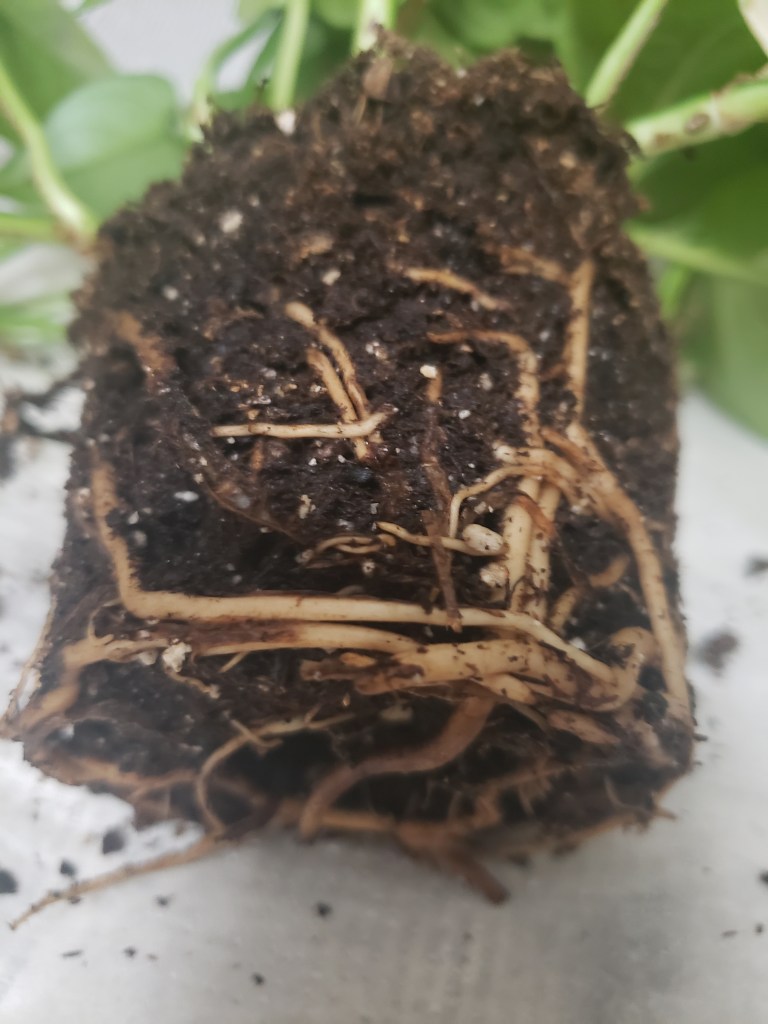
    The golden Pothos pictured above has a healthy set of roots, just beginning to take the shape of the container. Notice that the roots are around the bottom of the pot? That’s because I bottom water. After a number of decades of caring for houseplants I accept that I am a chronic over-waterer of houseplants. I especially try to baby them in the long, dark days of winter. I kill them with kindness and the need to garden. Now, I rarely plant directly into an ornamental container, I plant into an appropriate sized plastic pot. I lift the plastic pot to check the weight of the pot; if it needs water I place it in a container of water covering the drainage holes and let it soak up what it needs before returning it to the ornamental pot.

    The plant pictured above I only had to gently tease the roots apart, to keep them from continuing to grow around. Sometimes you may need to cut into the mass, sometimes you may be able to divide a plant into two or three pieces. Like pruning on the above ground parts, always remove dead/diseased/damaged and then you could remove up to a third of the root mass. You can re-plant in the original pot if you want, just remove enough root mass to fit into the pot.

    You can always water in a rooting hormone, if you’d like the extra assurance that things will go well. It’s generally not necessary, the plants will not be dormant for a few months and should root well. You should be lessening your application of any kind of fertilizer now and quit fertilizing by the end of October. As always, allow to dry out a bit between waterings. I’m just going to use a basic bagged tropical plant soil without fertilizer.

    1 comment on Time To Pot Up Houseplants
  • Are You Saving Seed?

    August 27, 2024
    Environment, Gardening, Mother Nature, Plants, Propagating, Seeds
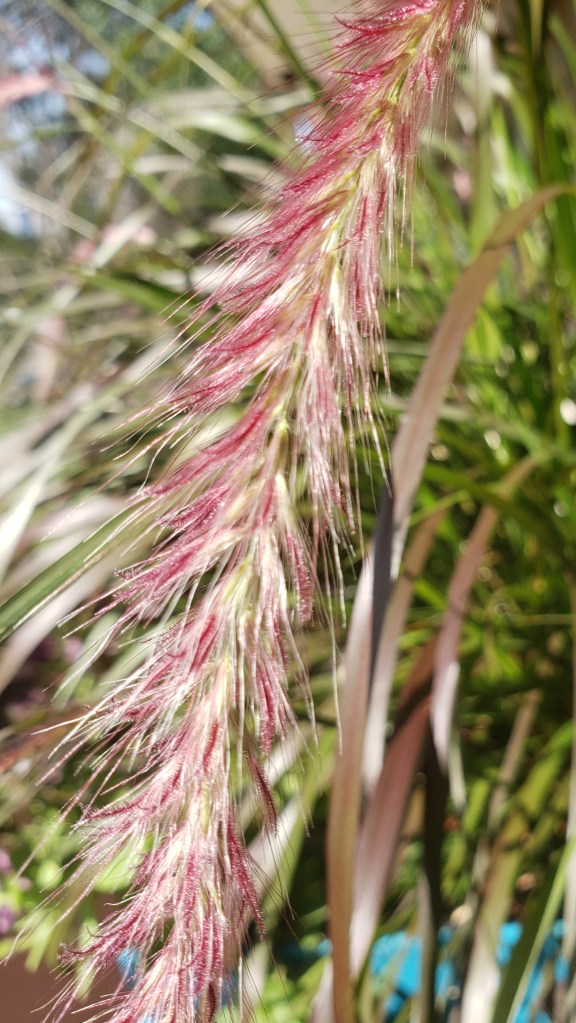
    Purple Fountain Grass (Pennisetum) Photo: PeaceSignsPruners

    I know we’re just enjoying this year’s bounty and beauty. Are you thinking about next year? Are you planning on saving any seeds? Patience is key in saving healthy seed. You may have a lovely little seed head now but is it mature and viable?

    Consider that a seed is like an egg in a bird’s nest. The seed coat is the shell, inside is endosperm which is like yolk and there is an embryo or little spark of life. The egg, when laid by momma bird, does not have a baby bird…yet. The mother must sit on the egg to keep is warm for the embryo to develop.

    So it is with plants. The seeds need to be attached to the mother plant for a little while to develop properly. Now it is a bit of a fine balance: critters and birds want to eat the seeds, wind wants to blow them to a new home. It is the yellow, soft cucumber that will have viable seed, not necessarily the small one you choose for eating.

    How can you tell? With peas, beans and flowers like milkweed the pod becomes brown and brittle. The ornamental grass pictured, purple fountain grass (Pennisetum) will get very beige and fluffy, then the small seeds will pull off quite easily. Most flowers develop a bulge right under where the flower petals were which will dry and eventually split, revealing the seed. Sunflowers hold their seeds in the centre head.

    If you are anxious to save a certain seed perhaps protect it by wrapping the developing head or pod with something breathable: paper, muslin or horticultural fleece will work well. Staple or tie it around the seed head to secure. Do no use plastic wrap or bags; moisture can be trapped leading to mold or the sun on the bag can super heat the contents essentially frying what’s inside. Cut the stem and bring the seed inside once you think it’s mature.

    We have to have a word here about what’s worth saving. Some seed will not be what you thought you were saving or the seed may be sterile. Seed must be pollinated to become viable. Yeah for the pollinators, we really need them! Plants can only be pollinated by those in their genus and often species; apple (Malus) cannot by pollinated by cherries (Prunus) even though they are both in the rose family. Squash are notorious for allowing pollination from their close cousins, so zucchini (Cucurbita pepo) can be pollinated by pumpkins (Cucurbita pepo) but not by butternut squash (Cucurbita moschata). The seeds you planted should only produce zucchini but the seeds you save could produce some odd cross-pollinated squash. If it’s tasty you can trademark it, name it and make a million dollars.

    Some of your well loved plants are hybrids or F1 hybrids, meaning they are like the offspring of zucchini and pumpkin crosses. They can produce wonderful new additions to our gardens but they may not be what you want when you save their seed. Many of the modern petunias, for example, are hybrids; the seeds are either sterile or produce something you do not expect. If you’re really in love with one of those plants it is better to take cuttings (clones) soon and keep the plant like a houseplant through the winter.

    Seed suppliers protect their stock by growing related plants far apart: separate fields or separate greenhouses. They may do fertilization by hand, then cover the flower or developing seed head to prevent other pollen from entering. As a homeowner with a small garden it’s impossible to segregate plants, even if you have some in the front yard and some in the backyard the pollinators can fly that far.

    Here is an excellent article from U of South Dakota Extension that helps explain the ins-and-outs of seed production. For over twenty years the book ‘Seed to Seed: Seed Saving and Growing Techniques for Vegetable Gardeners‘ has been our go-to. Happy to see that there is a revised edition out.

    2 comments on Are You Saving Seed?
  • You Need To Cure That!

    August 15, 2024
    Cooking, Gardening, Landscape, Mother Nature, Plants

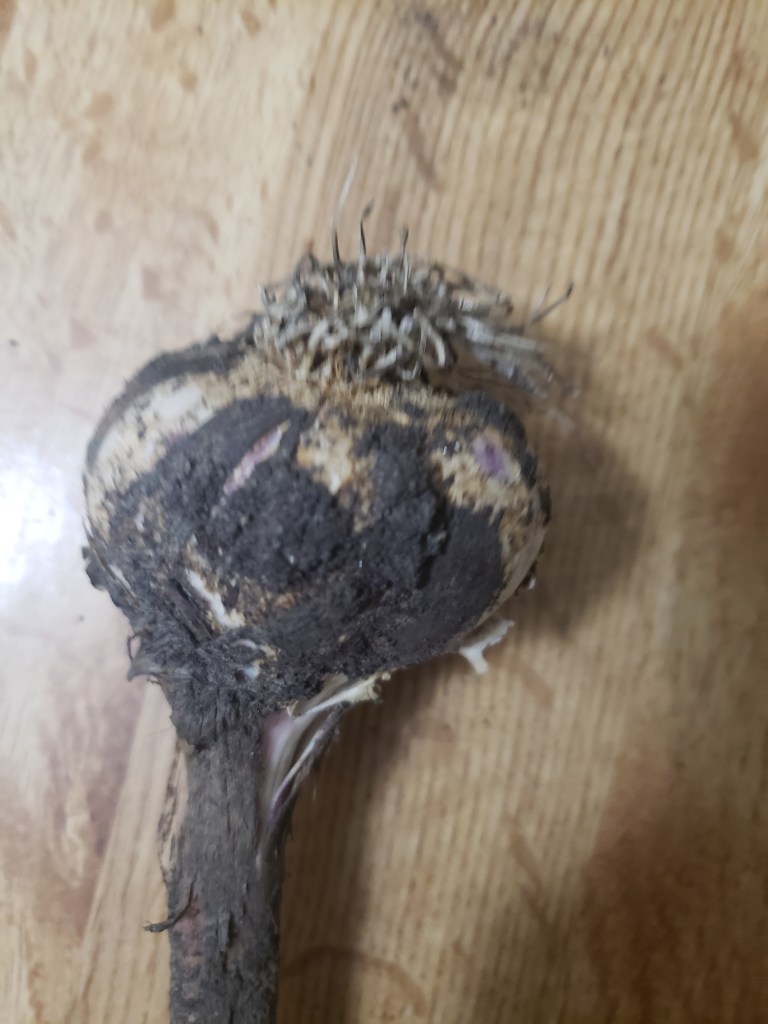
    How’s your garlic crop? Looking good? Leaves dying back? It’s time to harvest. For us in Zone 3 harvest is usually early to mid-August. Digging the bulbs is the hard work, but the work isn’t finished once you have everything out of the ground. If you want to enjoy your homegrown garlic all winter, you’ve got to cure it.

    Testing a few heads is always a good idea. Bulbs should be firm, garlic cloves filling the papery covering. As with all things in the vegetable garden, sufficient water during growing will give you a bigger product. Always loosen the soil with a spade, fork or trowel; do not pull heads as you can damage the stem which allows rot and fungal infections in. Treat these bulbs like gold – which they are worth their weight in! Be very gentle, don’t hit them or ding them!

    Do not, do not, do not, may I repeat: Do Not hose them down or rinse them off! Getting water on the bulbs invites rot: moisture can get into the root crown, under the papery cover of the cloves or into the stem. Do leave them dirty and leave them to air dry. They do not need to be in sun which can dehydrate the bulbs. Find a dim, cool area with good air circulation. If you don’t believe the air circulation is good put a fan on the area.

    I’ve always cured garlic and onions by simply laying them out on a table, often in the garage. I turn them regularly because rot will start where the bulb is in constant contact with the table. This is true of winter squash, potatoes and root vegetables. You can hang the produce or lay it on mesh screens, lessening the chances of contact rot. The curing process can take up to two weeks, if your weather is humid. The dirt should fall off or brush off easily. It’s when the curing is finished that I trim the roots and stems.

    Keep any produce that is dinged, stabbed or bruised for immediate eating, they will not store well. Cured garlic can last in a cool, dark space for months; the temperature, ideally, is around 12o C or 55o F. Warmer temperatures will cause them to desiccate or sprout to soon.

    Here on the Prairies we typically grow a hardneck garlic, which is a little tougher than soft neck garlics. This includes varieties such as Music, Purple Stripe, Porcelain and Rocambole. Hardneck garlics give us the delightful scapes in late spring, softnecks do not. Softneck garlics can be braided, hardnecks can not. Colder climates can grow softneck garlics such as Artichoke or Silverskin but plant a little deeper, mulch well and delay removing the mulch in Spring for as long as possible. I find the hardneck garlics more flavorful; I only tried to grow the softnecks and elephant garlic a couple of seasons before deciding to dedicate the space to hardneck varieties.

    Fresh, locally grown garlic is fantastic! If you’ve never used fresh garlic for roasting whole heads you are missing out. If you didn’t grow any this year do search it out at your local farmers’ market.

    No comments on You Need To Cure That!
Previous Page
1 2 3 4 … 12
Next Page

Start a Blog at WordPress.com.

Peace Signs and Pruners

Caring for Mother Nature While Making Her a Little Bit Prettier!

    • About
    • Search Categories


Loading Comments...
 

    • Subscribe Subscribed
      • Peace Signs and Pruners
      • Join 25 other subscribers
      • Already have a WordPress.com account? Log in now.
      • Peace Signs and Pruners
      • Subscribe Subscribed
      • Sign up
      • Log in
      • Report this content
      • View site in Reader
      • Manage subscriptions
      • Collapse this bar