• A Garden For Peace

    August 9, 2024
    Design, Gardening, Landscape, Mother Nature, Peace, Planet Earth, Plants, Travel
    ‘Promise of Peace’ Sculpture Photo: PeaceSignsPruners

    I love visiting gardens, private and public. When we’re travelling it’s one of the first entertainments that I search out at our destination. Imagine my surprise when I realized I’ve never visited the closest botanical garden, just an hour away. My excuse is that summer is busy time for us in horticulture!

    Holiday Monday (in Canada) we visited the International Peace Garden, located on the Canadian/US border. The garden will be 100 years old in 2032, and they are already planning the celebration. Plans started for the garden in 1928, with a vision of a garden between two great countries that celebrated Peace. We’re all about that here at ‘Peace Signs & Pruners’! Groundbreaking occurred in 1932 with more than 50,000 people in attendance from both sides of the border. The historical photos displayed are quite something.

    The visit was highly enjoyable. We first toured, by car, the North Drive. It’s mostly a natural, wild area, with some excellent picnic areas, hiking trails, camping and a kayak entry. There is some interesting information on a dam project with Ducks Unlimited. There are some beautiful vistas to Lake Stormon from all around the drive. Lots of birds and insects flitting about.

    View of the Sunken Garden from the top. Photo: PeaceSignsPruners

    We drove around to park and enter the more formal gardens. The Sunken Garden, with fountains and pools, was a delight to the eye. There are some fantastic bedding schemes of annual plants, as well as more permanent beds of trees, shrubs and perennials. There are many levels and views to enjoy. There is a pollinator garden, a kitchen garden, a play park for kids and so much more.

    We worked our way over to the Conservatory & Interpretive Centre. An display of succulents and cacti in a desert biome was incredible! Having worked in retail greenhouses for years, I’ve seen a lot of succulents and cacti sold as houseplants. So many in the collection I’ve not seen. I’ve been to the Phoenix Botanical Garden and the collection here rivals that. The cafe and gift shop are very nice.
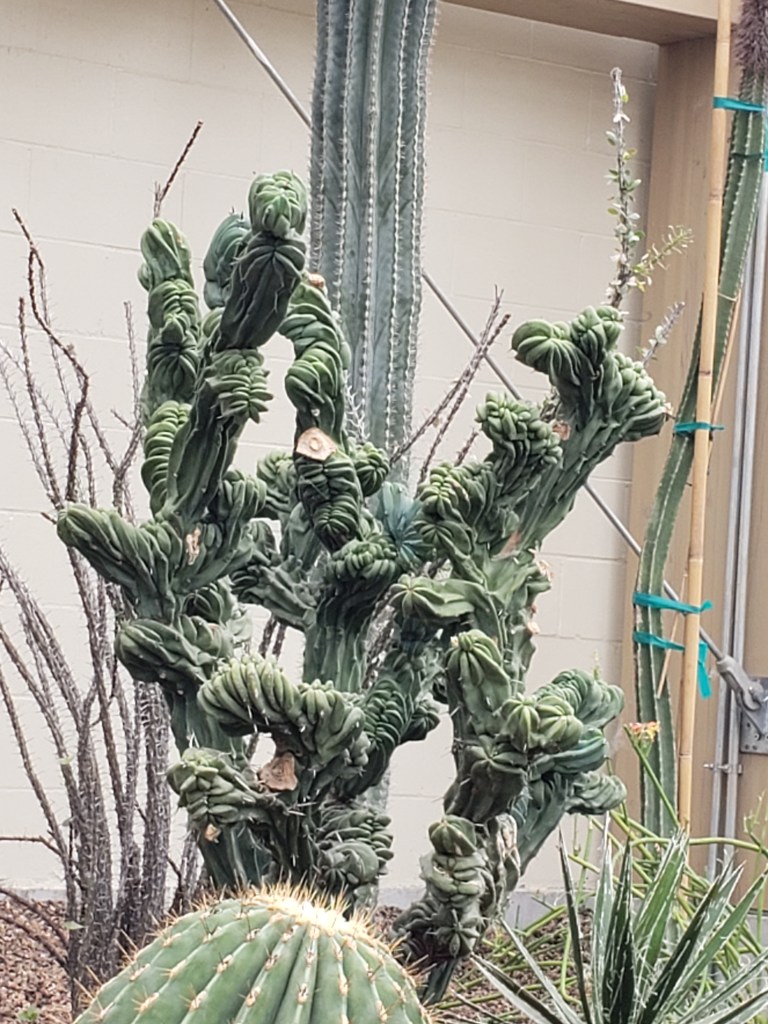
    In the Conservatory Photo: PeaceSignsPruners

    All in all a great afternoon. There’s a few problems I noticed. The annual plantings have not filled in very well, a product of our cool July, I believe. Most of the permanent beds in high profile areas were rather weedy. The gardens were busy, probably with the Canadian holiday, and staff were line-trimming in busy areas, like the gate to the Conservatory, leaving slippery clippings. As well, hoses were out, not being used, across pathways such as the kitchen garden and pollinator garden. Just not a great, safe environment. We are, admittedly, very conscious of safety and tripping hazards.

    The International Peace Garden is open year round, with skiing and snowshoeing trails. The Conservatory would be a delight in winter. Have you visited botanical gardens in your area?

    1 comment on A Garden For Peace
  • Annuals To Houseplants

    August 1, 2024
    DIY, Gardening, Landscape, Plants, Propagating

    How we love our annual flowers on the Canadian Prairies. While our hardy perennials, trees and shrubs have a short period of bloom annuals just keep going all summer right until frost. Did you know that some of the plants that we use in our summer containers are actually perennials and often evergreen perennials in warmer climates?

    Some of what is in your annual arrangements might make you a great houseplant. Deciduous perennials aren’t good because they want to take a break and die back. Tomatoes and peppers are evergreens in their countries of origin as are Hibiscus (Rose of Sharon), Musa (banana), although once it bears fruit it should be cut back to re-grow. Many ferns, which we do see sold as houseplants. Yucca, Aloe, Agave, cactus and most sedums work. I have friends on the West Coast who kept a Passiflora (Passion flower) going in a pot for thirty years. They would bring it in for winter and it would drop quite a few leaves, but it bounced back each Spring with a light pruning.

    Alternanthera, pictured above on the left, has a number of evergreen varieties with interesting leaves. The other vial in the photo has a petunia stem I broke when deadheading but it is a year round plant in it’s original home in the tropics. A number of the Tradescantias are evergreen, as well as Hedera (English Ivy). Many herbs like lavender, thyme and rosemary are perennial in warmer climates. Impatiens, particularly New Guinea, bamboo, Ajuga (Bugleweed), some Heuchera (Coral Bells), Coleus and Vinca (Periwinkle) can all come inside as houseplants.

    The trick here is to know what you’re growing and look it up to see if it is evergreen. If you don’t know what’s in your pots try ‘Google Lens’ or one of the plant ID apps like ‘Picture This’. Take a cutting or a good picture to the greenhouse where you got your plants. Find out if it’s worth your time to propagate.

    If you decide to propagate, now is the time to take tip cuttings. In the picture is my propagator, it’s cute as well as handy. Get it here. I always have something in it for decoration: cut flowers from the store, wild flowers from a walk or cuttings for houseplants. I have a number of Philodendron because of this set-up. I’m kind of craving the wall hanging version, see it here.

    Take at least three nodes (where the leaves come out on the stem), cut away the leaves on the bottom two nodes and stick in water. Really! It’s that easy with any plant that is soft and juicy. If you take the soft tips of plants that get woody, like lavender, you should still get some rooting in water. The other alternative is to take woodier cuttings, dip into a rooting hormone then into soil.

    Pot up your cuttings when you have a good set of roots. Don’t expect much of them in the winter when days are short. Don’t over-water. You have a nice houseplant or even the start of next summer’s containers! Watch for a further post about bringing whole plants inside the house.

    4 comments on Annuals To Houseplants
  • Do It But Don’t Do IT!

    July 27, 2024
    DIY, Gardening, Landscape, Plants

    Appearing now in your mailbox, inbox and in stores are fall bulbs. Stately tulips, bright daffodils, yummy garlic and more are, or will be, offered to the garden enthusiast.

    Do it! Buy them now, especially garlic which has been a fast seller the last few years. During the pandemic, with the food shortages due to shipping problems, people have been more interested in growing their own food and garlic is an easy and popular crop. Fancy tulips like doubles or fringed, special colours, double or rarer pink daffodils can all sell out quickly.

    Don’t, however, plant them yet! No planting until mid to late fall. They are called Fall Bulbs for a reason! They need to go into the ground when days and soils have cooled considerably. If you plant in the heat of summer they will react and start to grow. They will have leaves up by early September, might try to bloom by early October and then will be killed by frost. Waste of money, waste of time.

    How to store bulbs until you are ready to plant? Some of the guess work can be eliminated by ordering online from a reputable company, like Veseys, pictured above. We are long time fans of this company but you can get great product from Botanus, Brecks, MacKenzie and Wildwood Express, all are well worth checking out. These companies will ship at an appropriate time for your area and garden zone.

    Careful ordering from that massive online website, there are many scams. Just so you know, there is no such thing as a blue tulip, don’t fall for it. If you find bulbs in a garden centre or box store, check them out carefully. Sometimes appropriate storage can be a problem and they have them in a sunny, warm spot. Bulbs should not be budding or actively growing, they should be firm to the touch.

    So you got happy and acquired bulbs. What now? Keep them in breathable packaging like paper bags or perforated plastic. Keep them in a cool, dark place. In our modern sealed home this can be a challenge so you can store them in the refrigerator. Keep them away from fruits, which produce ethylene as they ripen which can stimulate your bulbs. If you are going to be storing them for two months or more it maybe be better to individually wrap the bulbs in newspaper, paper towel or brown paper. Where the bulbs touch is where rot it most likely to start. Keep an eye on them to make sure there is not condensation on plastic bags.

    When to plant is something I cannot tell you: it’s a weather thing. It is, for us on the Canadian Prairies, usually late September at the earliest. I will be writing more about planting fall bulbs as the planting time draws nearer, sometime around mid-September. Subscribe so that you don’t miss a post.

    2 comments on Do It But Don’t Do IT!
  • Maximize Spring Bloom

    July 23, 2024
    DIY, Environment, Gardening, Plants, Pruning
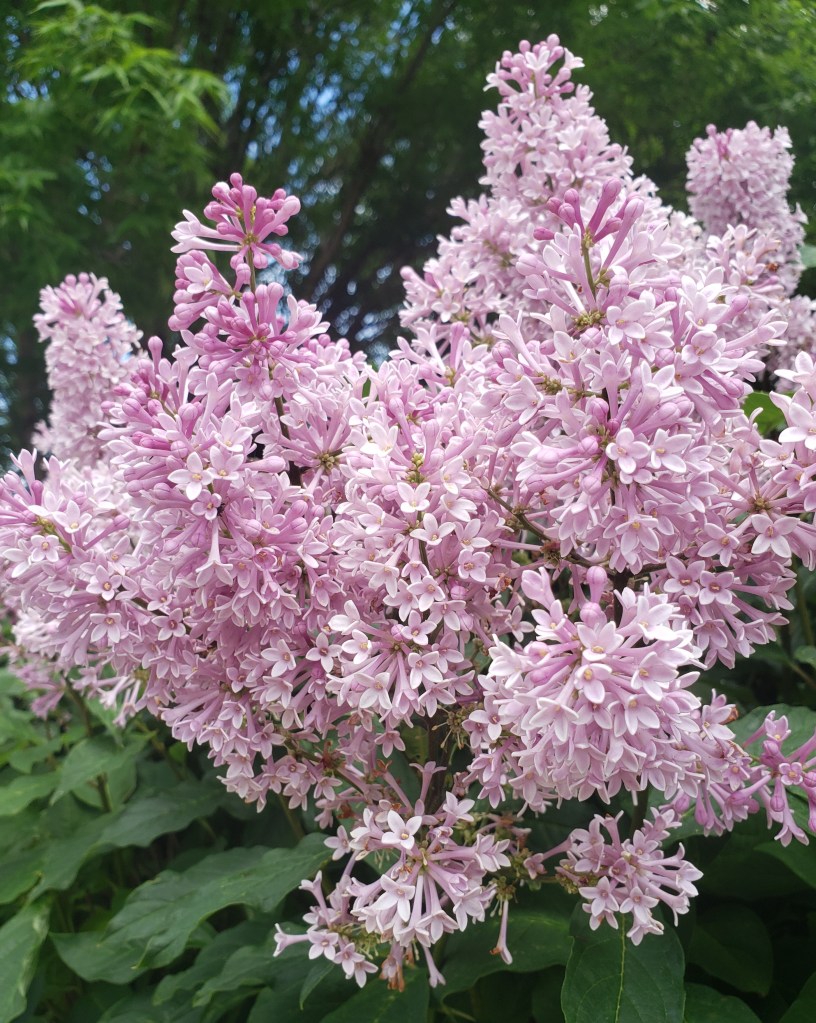
    Lilac Photo: PeaceSigns&Pruners

    Did you know that spring blooming trees and shrubs will make their blooms the previous fall? Next springs’ bloomers make their buds on old wood, wood that grows this year. Through late summer and fall, they form the flower buds for next year. The blooms are tightly furled and protected by a hard bud case or shell.

    To maximize next springs’ blooms do your pruning now. Once your shrubs and trees have finished blooming it is a good time to do any thinning, shaping or reduction in height. However, you need to get it done by mid-summer, to avoid taking any formed blooms. This is especially important for cold-climate gardeners, who have a smaller window of opportunity.

    Hardy shrubs and trees that bloom on old wood include forsythia, lilacs, mockorange, purple sandcherry, ninebark, azaleas and rhododendrons, weigela, some spirea, some honeysuckles and most of our fruit trees and shrubs. When pruning fruit producing trees and shrubs be careful to not damage your current fruit!

    Remembering when your plants bloom is one great reason for keeping a garden journal. If you have trouble remembering come fall here is a great chart from U of Colorado. The chart has plants we can’t grow on the Canadian Prairies but is helpful if you’re trying to push the boundaries or have a great microclimate. I grew a deutzia for many years, said to be hardy for Zone 4. I admittedly had a great microclimate, a sunny yard well protected on four sides by mature shelterbelt and the house.

    As always, follow up pruning with some love and care. Water well in the drought of summer and add light balanced fertilizer or compost. While you’re out there, check the trunks of any of your trees and rub off any sprouts before they become branches!

    2 comments on Maximize Spring Bloom
  • Hedge Now!

    July 19, 2024
    Design, DIY, Environment, Gardening, Landscape, Plants, Pruning
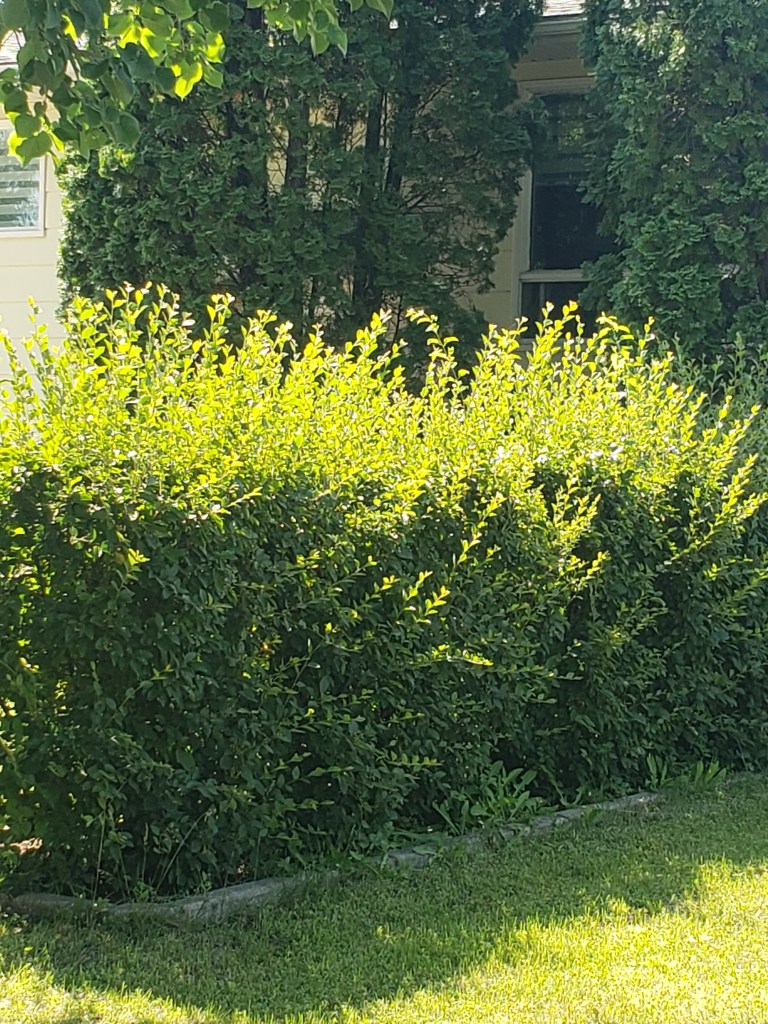
    Cotoneaster hedge. Photo PeaceSigns&Pruners.

    If you are in a cold climate, like the Canadian Prairies, now is the time to do your hedge trimming. If you’re anywhere else in the country this post is a little late for you but mark two to four weeks earlier in your gardening journal for next year. Sorry, but I tend to write as I see inspiration and this morning’s stroll brought the subject to mind.

    If you are working on a formal hedge with a straight top and sides your hedge is probably looking quite ragged. That is because all the exuberance of spring growth has happened. New shoots everywhere! Now that summer is upon us, growth will slow down.

    Whether using an electric hedge trimmer or manual shears sharpen your blades first or you will end up with ragged cuts. Manual shears are acceptable for shorter lengths, but are a very good arm workout. Of course, you do not have to do it all at one time but within a week is good. If your yard is surrounded by hedges an investment in an electric trimmer is a present to yourself. Chainsaws are not the best choice because they are not meant for fine work.

    Dwarf lilac. Photo PeaceSigns&Pruners.

    A crisp top line can be achieved by running a string at the height you want to achieve for reference. A pole at either end of the work area with a string between gives you a good guide. You can eyeball it but I’ve seen that often end in disaster with a wavy top, especially if your ground is uneven. Now, here’s a hot tip: when doing the sides of your hedge, your top should be a wee bit narrower than the bottom. That way the sun can get to the side growth evenly, without a bulging top shading the growth below. If you are working with a taller hedge using a ladder, please please please only work in sections you can easily work. It’s a bother to be getting up and down the ladder to move it but over-reaching is a recipe for disaster and injury!

    After you’ve hedged please follow up with a little love: water if your area is in summer drought. A light fertilizer is appropriate, but get that on quickly, you do not want to be fertilizing in August. You will get some growth through the summer, enough to cover your cuts, but it will be minimal and can be easily cleaned up later in August or September.

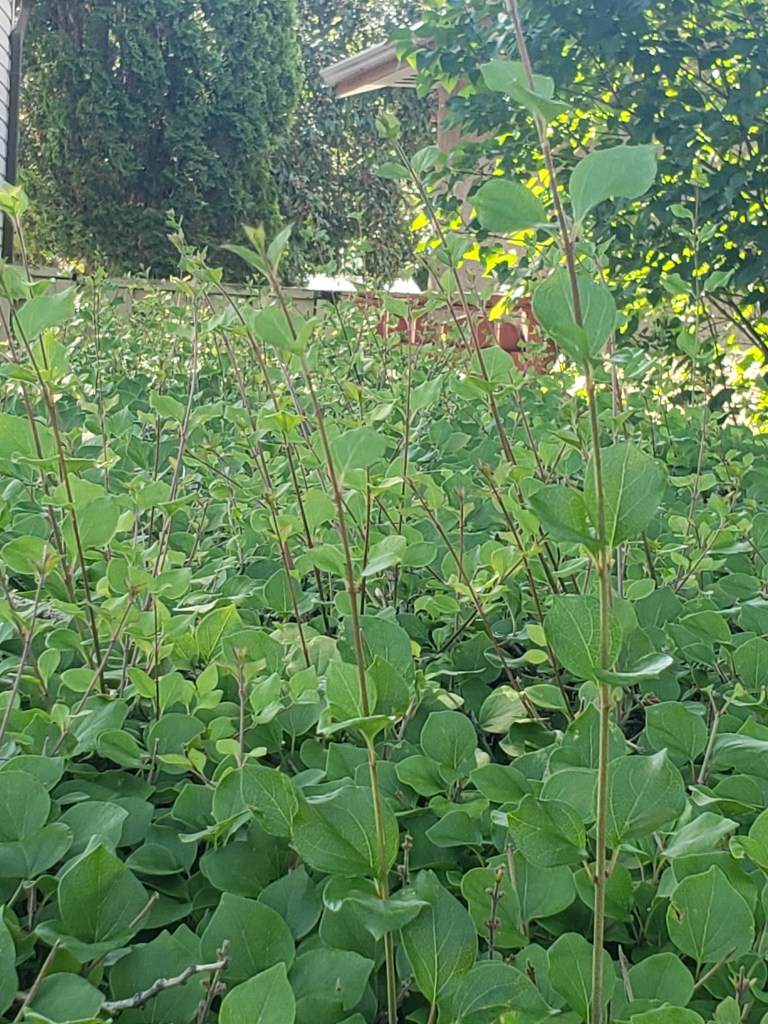
    Probably a Preston Lilac. Photo PeaceSigns&Pruners.

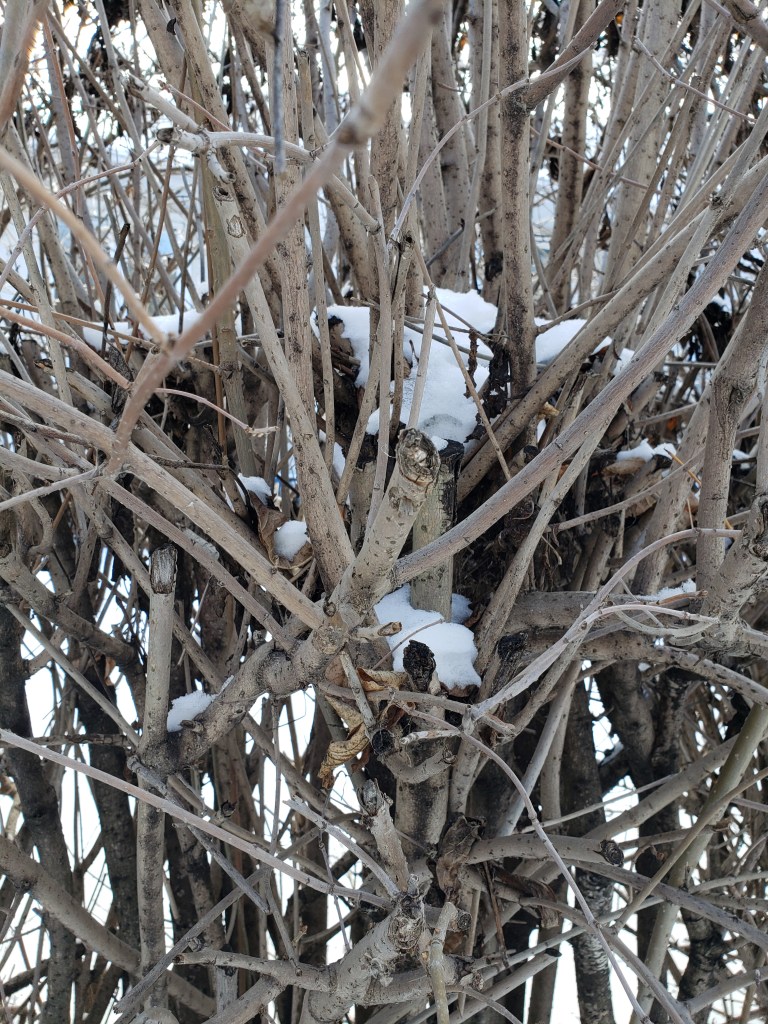
    In long term maintenance remember that plants only grow at their tips, they only add length at the ends. When you trim an end, dormant or hidden buds break back along the branch for six inches to maybe a foot. This means that your plant can get too dense. It’s an evolutionary protection so that a plant can rebound if eaten by a deer or is broken in a storm. As you hedge, you’ll get a plethora of new shoots below your cuts. This can lead to a top that is too dense, branches that rub and can be prone to disease as well as being an excellent home to bugs like spiders.

    As well, as plants get new growth at the top, they tend to focus energy there and not on the bottom. This leads to bare bottoms. As your hedge matures you should go in every year and trim out one or two old branches. You should also trim some of side shoots. Removing a big branch from the bottom will keep your shrub shooting at the bottom, preventing bare spots.

    If you’re looking for inspiration check out Instagram’s @hedgelover_ or use the hashtag #hedges. You may also get some adorable hedgehogs!

    1 comment on Hedge Now!
Previous Page
1 2 3 4 5 … 12
Next Page

Start a Blog at WordPress.com.

Peace Signs and Pruners

Caring for Mother Nature While Making Her a Little Bit Prettier!

    • About
    • Search Categories


Loading Comments...
 

    • Subscribe Subscribed
      • Peace Signs and Pruners
      • Join 25 other subscribers
      • Already have a WordPress.com account? Log in now.
      • Peace Signs and Pruners
      • Subscribe Subscribed
      • Sign up
      • Log in
      • Report this content
      • View site in Reader
      • Manage subscriptions
      • Collapse this bar