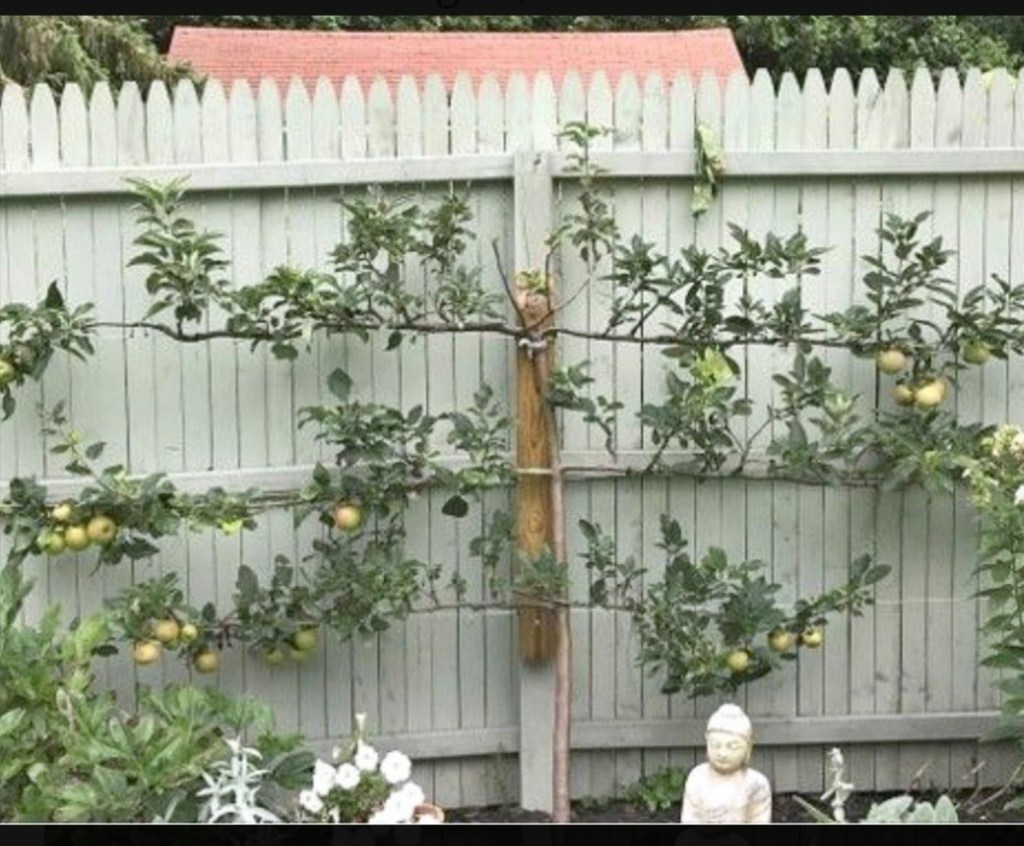
Much as you’d love to grow more of your own food, you say you have no room for fruit trees? I beg to differ! Let me introduce you to the ancient art of espalier. If you’ve ever visited a vineyard, or seen pictures of one, you’ve probably seen espalier in action. It is the process of growing horizontally, or flat, on trellis, fence or wall.
There is evidence of the use of espalier in Roman times. It became very popular in Medieval times, when people lived in walled castles; the possibility of sieges caused gardeners to grow as much food as possible in small spaces. Plants like roses could be grown to beautify the stone walls of small courtyards, as well as fruit trees to provide sustenance. Home gardeners started using the technique to provide for their families, even in a tiny cottage garden a fruit tree could be grown.
The science of espalier is based on the theory that less branches and leaves, the more energy to produce fruit. The plants are grown on a frame of trellising or using wires attached to rings or screws. A fan shape is common but almost any shape can be achieved. Grapes are grown on fences so that all the branches and fruit are between shoulder and knee height, making the maintenance and harvesting of fruit easily within reach.
Espaliered fruit needs to be in full sun; at least eight hours per day. They are often grown on the walls of the house or on fences, providing protection from weather as well as creating a ‘heat sink’ as the building absorbs heat during the day and releases it slowly in the evening. A young tree is planted, and then any branches or shoots growing backwards or forward are pruned out. As the plant begins to grow in Spring tender new shoots are attached to the frame. Like bonsai, the manipulation begins when the young shoots are pliable; by the end of our growing season the new branches harden and become too woody to change.
It may sound complicated, but it’s not really! The work, for us in Manitoba, will mostly be in May and June, when the tree is actively growing. You perform your pruning and tying in then; some growth will occur through the summer and the tree can be tidied up in fall. Best choices for fruit? If you are only going to try one espalier, apples are probably the easiest as they are readily pollinated by ornamental crabapples as well as other apples and you probably have a pollinator within your neighbourhood. A pollinator needs to be within a couple of city blocks and the birds and the bees will do the rest. Plums are very choosy about what will pollinate what, pears and apricots need a pollinator but you may not have one close enough in the neighbourhood. Hardy grapes can easily be two plants on the same framework, giving in-house pollination.
The framework is often o-screws or cup hooks, with sturdy fishing line or light wire strung between points. Bamboo or willow poles can be used as well. Your plant needs to be away from the wall or fence by at least six inches so that there is good air circulation around the plant. There are many detailed instructions online such as on YouTube, just search ‘espalier’. Give it a try on a sunny fence and enjoy your homegrown fruit!
This article first appeared in the magazine ‘Neighbors of 34th Street. It has been updated and revised.


 Peace Signs and Pruners