Are plants singing and making music? TikTok led me down an interesting path. Isn’t it a charming idea? Plants are out there creating symphonies that we simply cannot hear.
There is evidence that plants communicate with each other, read more in this research from National Geographic. They can send signals when they are stressed, which sometimes cause pests to attack but can also warn other plants. Read more about that here.
But are they making music, like some TikTok accounts claim? TikTok accounts that might like to sell you a device to listen to said creations? Science seems to say no, they are not making music. They are releasing electric impulses which can be construed as tunes, when put through a synthesizer. Check out this piece or the study done by the music department at Pittsburgh University.
Some creators on social media are turning this into a ‘mystical’ experience. Listen to the mushrooms, listen to the music of the universe and such claims are being made. As always, careful what you accept as fact!
Are you looking for a gift for someone who likes to get out in nature? The Japanese have a wonderful term: Shinrin-yoku. It literally translates to ‘forest bathing’. Just getting outside in Mother Nature, walking or sitting, breathing fresh air, hearing the natural sounds is good for your health. Time Magazine has a lovely article here. Nature lovers aren’t necessarily gardeners, so it’s a whole different set of gifts.
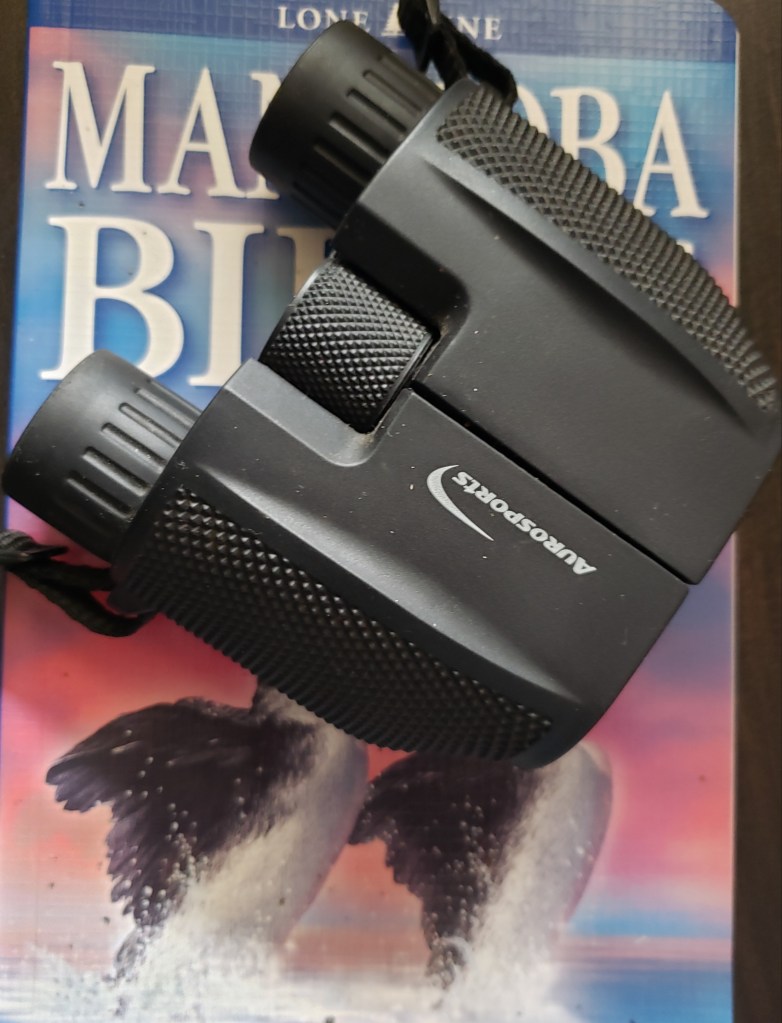
One of my favourite purchases as we were able to travel a bit more was a pair lightweight of binoculars. We had excellent binoculars but they were heavy and cumbersome to carry in a hard leather case. We have these and they are so easy to take along on a hike. They can go in a pocket and are much more discrete, if you’re travelling to a local that’s a bit wild.
If your Nature Lover is getting into photography, consider a close-up lens attachment for their mobile phone. It can help make fantastic zoom photos among other things. This kit here has a number of different attachments.
If they are getting into photography, it may be time to help them get their first camera. If they own a camera, consider providing the close-up lens or macro lens, even a telephoto lens. Maybe they’d appreciate a photography course at the local community college.
Now that they have all these photos and memories, now they need some reference material! In the photo above is our much-loved book on Manitoba Birds. Second copy actually, misplaced the first copy. Lone Pine Media has great reference books on birds, trees, mushrooms, all kinds of things for across Canada! The Manitoba book seems sold out on Amazon, although I recently got my copy at Riverbank Discovery Centre, where there is a great selection of books for naturalists. This series looks very interesting, too. Where ever you are, there are books written for your area. I also like the brochure style, we have a number for Costa Rica for hikes when we might not get phone service to just ‘Google’ something. The Pocket Naturalist is just one company making them and they’ve got them for around the world. Anywhere your giftee may be thinking of travelling you can find some reference material.
What else for the Nature Lover? Well, how about a membership in a group supporting Mother Nature? Nature Conservancy Canada has an adoption program, so one can adopt a species or a habitat. Every adoption comes with a certificate, a booklet on your choice and a calendar. Pollinator Partnership Canada is celebrating ten years and is offering again the Pollinator Steward Certification. It’s an online course, perfect for someone wanting a more active involvement in nature.
There is a few things for you to think about! Hope that helps!
Most of my links lead to further information. This post has affiliate links which, if you purchase through the link, I may make a teeny tiny commission. All prices as of the day of publishing and may change.
Most of my links lead to further information. This post has affiliate links which, if you purchase through the link, I may make a teeny tiny commission. All prices as of the day of publishing and may change.
At the start of almost every season that I have worked at a garden center management has given me a pair of secaturs, or hand pruners. I’ve usually killed them before the season is over. They become wobbly, the blade won’t sharpen, the spring has fallen out and gotten lost. Admittedly, I do a lot more pruning than the average gardener. A shipment of one hundred potted trees and shrubs may arrive, and the way they are crammed on the truck at least a quarter of them have broken branches that need attention. Ultimately, I always go back to my own secaturs.
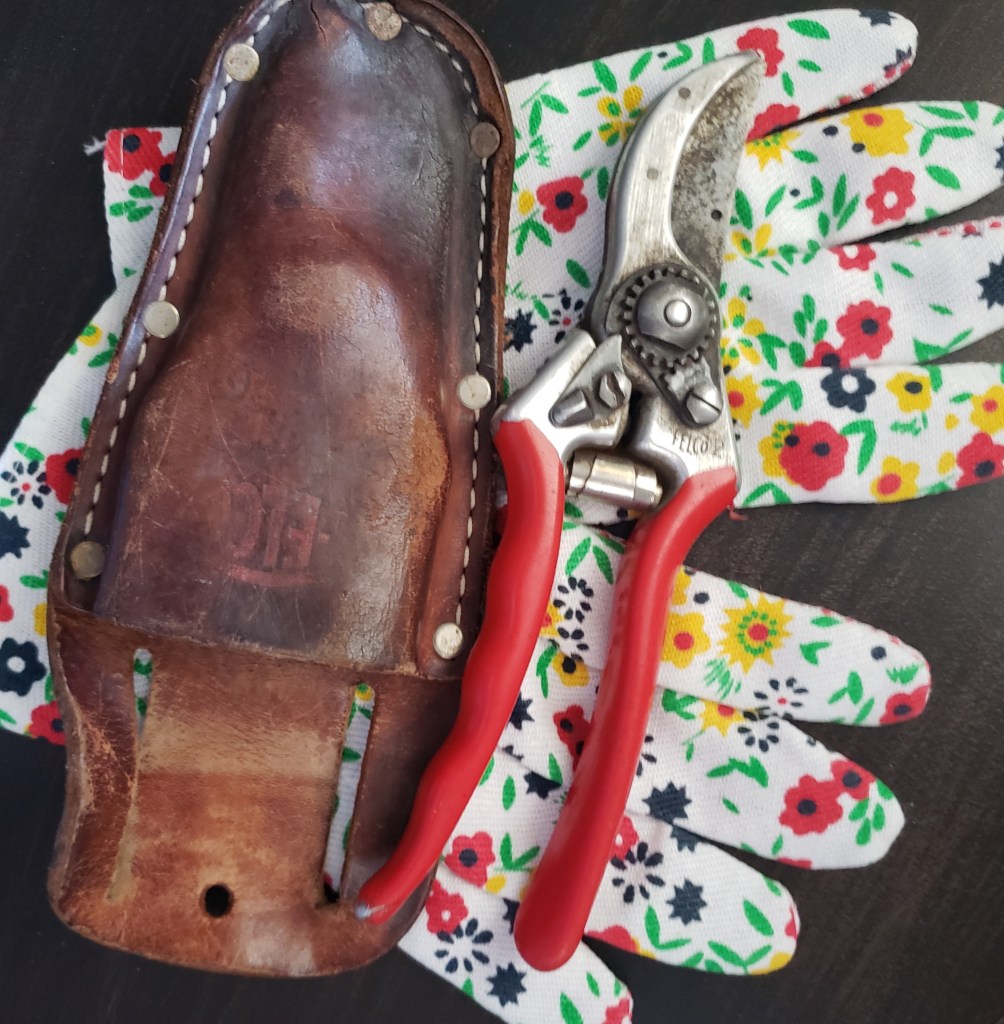
My Felco #2 and holster are over thirty years. Yes, that’s the secaturs in my profile picture. They’ve seen a lot of pruning. I purchased them during hort school, and used them while running a landscape design/build/maintenance company with my husband. As I was, at that time, certified as an arborist, I did a lot of pruning. The pruners were sharpened weekly and I’ve only had to replace the blade once. Never lost the spring. They’ve stayed balanced and strong. Our dog Teddy Bear tried teething on them, and the paint didn’t even peel off around her teeth marks. On the farm, they’ve pruned everything from raspberries to corn.
Any gardener would appreciate quality tools. Whether they are a new homeowner or someone becoming more involved in their gardening I highly recommend good pruners, like my Felco #2. If you can splurge, get them the Felco holster, too. So convenient to whip out the pruners while you’re mowing the lawn or doing some weeding. With a pair of pruners one should be able to prune anything up to the size of one’s own little finger. Anything bigger you need a pair of loppers, and bigger than one’s thumb you need a pruning saw. You can get other great accessories like sharpeners and oil.
A good set of shovels, spades, rakes and hoes are a must, and I’ve always been impressed by the tools from Lee Valley. The ash handled, ergonomic tools are something else we’ve had for decades and used more than most people would in a lifetime. This spade is a favorite. Now, the ash handled tools are more expensive…but you have to pay for top notch quality, right? I’m a huge fan of a D-hoe, also called a scuffle hoe, at Lee Valley called a Hula Hoe. The only hoe I need, a great tool!
Some other things from Lee Valley that I’ve had for decades are a steel compost bucket for under the sink, a folding plastic mat with sides for potting plants indoors and a set of small stainless steel cups perfect for dipping sauces, snacking on nuts or dried fruit, measuring out spices before starting to cook. The links to Lee Valley products are not affiliate links, I don’t think they do that. I just really like their products. Great things for gardeners, cooks, DIYers and woodworkers.
If your gift recipient is interested in vegetable gardening or houseplants there are a ton of great things. If they are a balcony gardener or have a small yard perhaps rent them a plot at a community garden. I’ve seen these raised beds in action and they’d be appreciated. They are attractive and functional; they could go at the end of a patio or deck to provide privacy, along a fence or lining a sidewalk.
If your giftee is a houseplant enthusiast or getting into starting seeds they need a set of grow lights. Grow lights must be height adjustable; the lights start very close to the seedlings and are raised as the seedling grow. Leggy seedlings come from reaching for light. I have had a system like this grow light here. It’s adjustable, lightweight and easy. I’m also a big fan of the grow bulbs that fit into any lamp, I have these grow bulbs here. I’ve currently got one in a standing lamp in my living room with houseplants around it.
Anybody starting seeds needs a heat mat, growing medium and little flats or pots. Do support your local greenhouse in this holiday season and you’ll probably find exactly what you need. For those particularly eco-friendly I’ve used this newspaper pot maker for years. Great way to upcycle newspapers, which these days are generally on unbleached paper with vegetable or soy inks. Seeds are started in 72 or 124 cell flats then potted up to the paper pots, which can be directly planted in the garden and will biodegrade. Perfect for things with brittle roots like melons and cantelopes.
For stocking stuffers and less expensive ‘Secret Santa’ gifts magazines are a great choice. For new gardeners I always choose something written for their area, information they can use. The Gardener For Canadian Climates, published four times a year or available on the newsstands is a good choice. For the dreamer or experienced gardener I adore some of the British publications like ‘Gardens Illustrated’ or ‘BBC Gardeners World’. From America there is ‘Fine Gardening’. The newbie gardener has to understand that they can’t grow half (or maybe three quarters) of the plants featured in the last three magazines but the knowledge and photography are top notch. ‘The Old Farmer’s Almanac’ is also a fun choice with weather predictions, gardening advice, animal husbandry, moon phases and so much more! Great reading on a cold winter night. There is a Canadian and an American edition.
Books on the topic are always welcome. Again, I like things that are appropriate for the area, especially for newbies. As a cold-climate gardener I have forever been a fan of writings by Lois Hole, Sara Williams, Hugh Skinner and Bob Bors. Those books are all getting old now and don’t include varieties developed in the last twenty years. Some great new plants have been introduced that aren’t mentioned or there are named varieties you can no longer buy. I’ve been quite impressed with the recent series ‘Guides For Prairie Gardeners’ by Janet Melrose and Sheryl Normandeau. With the interest in growing fruits and food I recommend this book from the series. For something more exciting and cutting-edge here’s a link to some of the recommended books from ‘Gardens Illustrated Magazine’.
Probably Philodendron, at Puerto Viejo, Costa Rica. Photo PeaceSignsPruners.
One of the most fantastic things about travel, for me as a plant geek, is seeing plants in their native habit. Or seeing things we think of as houseplants or annuals out in the landscape as perennials. Hibiscus hedge? Oh, yeah! Arriving in Rome and seeing those iconic pencil thin Cypress (Cupressus) and then stroking them and inhaling the fragrance. Lovely!
This love of plants is one of the reasons Costa Rica has become a favourite destination. It is known to be one of the most eco-diverse places on the planet, with more plants, birds, butterflies and more critters, including the famous sloth. You can get up in the morning, catch the sunrise in the evergreen jungle of the east coast, drive to high elevations and be in misty cloud forest for afternoon tea and still catch sunset in the deciduous forest of the west coast.
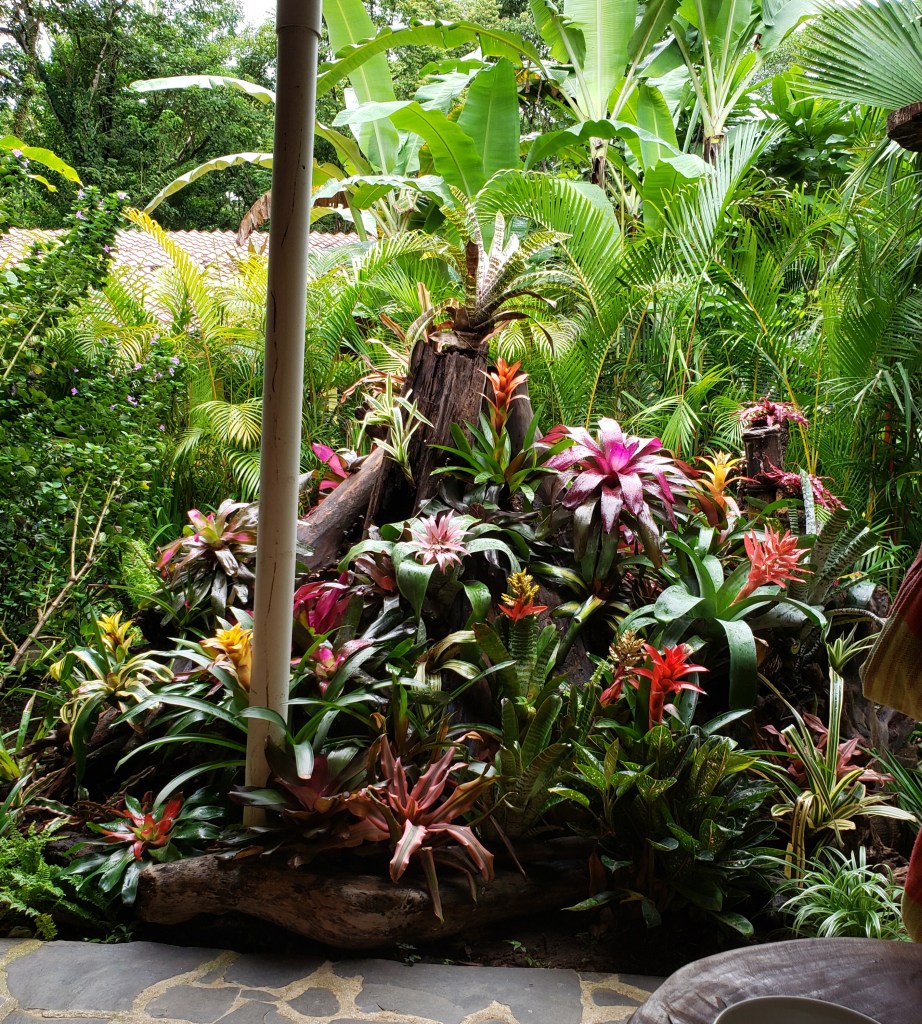
Merlin’s, Playa Cocles, Costa Rica. Photo PeaceSignsPruners.
I love the mix of tender (for us) plants you can find in the landscape. Peace lilies and ZZ plants in the border, creeping fig climbing a six foot concrete wall. Yes, a hedge seven feet tall of flowering hibiscus, which I have struggled with as a houseplant. Too many photographs are taken just walking down an alley.
Want to do some good while you travel? We still can’t choose if our airline is using ‘eco-friendly’ fuel but we can choose more sustainable hotels on many of the apps. Have you heard of Pack With A Purpose? If you can make a little room in your suitcase you bring to your destination something the local community needs. You can choose from different groups including animal rescue, for example, who may be needing puppy pads or tick medication. Or simple search the area you’re visiting for dog rescues, schools, botanical gardens, beach clean-ups. They’d appreciate something you could slide in the suitcase. Large garbage bags, heavy duty gloves, crayons are just some of the things that might be needed. Leaves you a little extra room for the souvenirs on the way home, right?
We adore all winter squash. When we were on the farm, we had a root cellar and could keep the squash we grew right through the winter. I would go move it around once a month; rot tends to set in where the skin touches a surface. If something was looking over-ripe, or getting a soft spot I would preserve it.
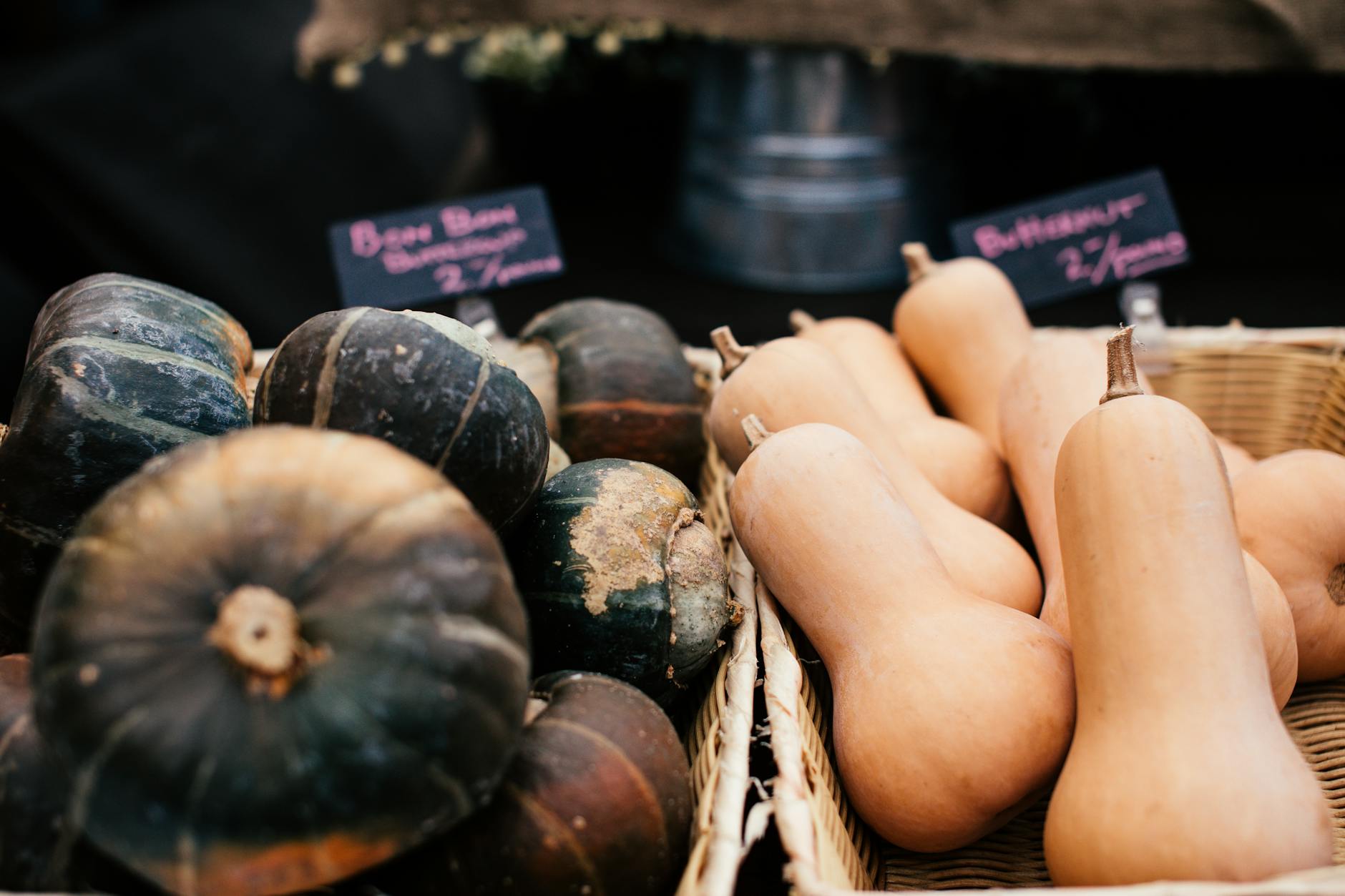
I’m finding this apartment is too warm to keep squash well. There just isn’t a cool place anywhere. And I do tend to over buy; love supporting the local growers! So today I was preserving some butternut and acorn squash.
I simply cut them in half, scoop out the seeds and roast at 375 F, for about an hour. I am really casual about this, I’ve done it for so many years. I don’t puree the flesh, I just mash it a bit with the fork I’ve used to remove the flesh from the skin. A little butter but no seasoning because I will use these for sweet as well as savory cooking. I then pack them in two cup portions in freezer bags for flat stacking in the freezer. It can be a little messy but I feel like I’m being ‘crafty’ or DIYish.
What will I make with these? No canned pumpkin puree in this home! I do the two cup portions because it’s just what I need for this awesome muffin recipe. Two cups is also a good size for a pasta sauce like this delicious Butternut and Bacon pasta sauce. My portion is a little big for this Oatmeal Butternut Cookie but a half a cup of puree can glaze some carrots or something. Remember, all the winter squash are interchangeable so oatmeal acorn cookies could be a thing, or Delicata and bacon pasta sauce. A Hubbard squash is still my favourite for a ‘pumpkin’ pie.
While you’re working in the kitchen you could roast the seeds for snacking. All winter squash seeds are edible. The pumpkin seeds that can be purchased as pepitas are a special type of pumpkin called an Oil Seed, Stygian or hulless pumpkin. The seeds from your Halloween decoration will not be as yummy. You can, of course, save seed to plant next year unless you have a hybrid variety. The acorn squash ‘Celebration’ is a hybrid of Acorn and Delicata and will not come true from seed. You will most likely get something edible but the shape and colours may vary. A seed catalogue should state whether the offering is a hybrid.
When we were on the farm we found our chickens and goats loved raw winter squash. For the chickens we would cut it open but the goats got them whole. It was quite amusing to watch them trying to break into a hard-shelled squash. Nothing goes to waste!

 Peace Signs and Pruners