• Who Is Working For Peace?

    November 17, 2023
    Peace, Planet Earth
    Photo by Steve Johnson on Pexels.com

    Narges Mohammadi has been working for peace and freedom. Even from her prison cell in Iran’s notorious Evin Prison, 2023’s Nobel Peace Prize winner continues to take a stand. Ms. Mohammadi was arrested in November of 2021 for “spreading propaganda”, sentenced to two and a half years, eighty lashes and financial fines. It was her 13th arrest by Iran’s totalitarian regime. The press release for her award is here.

    Ms. Mohammadi is the fifth Nobel Peace Prize Laureate to be in jail at the time of the presentation of their prize. Ales Bialiatski of Belarus, the 2022 Laureate, was in prison when his prize was awarded, serving time for “tax evasion”. In March of 2023, he was sentenced to an additional 10 years for “cash smuggling” and “financing actions and groups that grossly violated public order” according to Wikipedia.org.

    Obviously, working for peace is a dangerous undertaking. In the last few weeks news reports are stating the at least 50 people were arrested in San Francisco at a protest in support of a ceasefire in Gaza a further 500 were arrested in a peaceful sit-in at the US Congress. A Russian artist, Alexandra Skochilenko was recently sentenced to seven years for “false information” when she swapped supermarket price tags for messages condemning the Ukrainian War. The organization Human Rights Watch has released its’ 2023 report, it’s rather stunning. Check it out here.

    I must confess I wouldn’t be a very good peace activist. I don’t like big crowds but I have and would attend a peace rally…until things start to get boisterous. Then, I’m out of the there. So, I’ll help from here. Keep an eye on COP28, the Climate Change conference November 30 to December 12, 2023. Peace will be a theme, focusing on climate change and communities already in the midst of violent struggles. Check out the United Nations, which has always worked for peace. Here’s a great list from Impactful Ninja on some different organizations working for peace.

    I wish for peace. I do not know how we change eons of greed, the desire for conquest, the need for domination that humans have exhibited. For all of us, maybe we can just be a little kinder to those around us. Maybe we can be less judgemental, less competitive, more giving, more considerate.

    Peace to you all!
    1 comment on Who Is Working For Peace?
  • A Great Gift, But A Deadline

    November 15, 2023
    Design, Environment, Gardening, Landscape

    Bee City Brandon in Manitoba has created a beautiful calendar for 2024. It’s a fundraiser for the re-wilding of Eleanor Kidd Garden, a treasure destroyed but flooding. Orders should be in by November 18th.

    https://www.facebook.com/photo?fbid=657598336558054&set=a.502454022072487

    The calendar would be a great Christmas gift for so many people! First, it’s beautiful; the photography by local artist Cynthia Korman is stunning. Any nature lover would adore this. Any gardener interested in beautiful, hardy plants would love this, and learn new things all year! Anyone interested in helping pollinators would make good use of this. Anyone interested in native plants on the Prairies would value this calendar. Teachers could use it in the classroom.

    The calendar is raising funds to rehabilitate the now derelict park. The City of Brandon has no funds available (think new bridge), and must consider the costs of investing in a park that may flood again in future years. That is why they invited Bee City Brandon to develop a pollinator-friendly, native garden that could be beautiful and withstand flooding.

    The calendar is just one of the many ways Bee City Brandon is raising money. The committee has been applying for grants and working on other projects. The work will be almost entirely be done by volunteers so if you’re in Brandon, with fond memories of Eleanor Kidd Garden, sign up here to volunteer some weeding or planting new year. Hopefully I’ll see you there!

    1 comment on A Great Gift, But A Deadline
  • Rocks Are Low Maintenance

    November 8, 2023
    Design, DIY, Gardening

    Photo: Peace Signs & Pruners

    Every season that I’ve worked in a garden center someone invariably seeks help to create a no maintenance garden. Well, sorry, that’s only going to happen if you let your property go derelict. Then your neighbours will complain to the city, the municipality or the HOA and you’ll be served orders, you’ll be fined…it will be a mess!

    If you really want no maintenance you must have the budget for hiring professionals to do your gardening or move into a condo or townhouse where things are taken care of as part of your fee structure. Even if you paved your entire yard sooner or later some dirt will blow into the joints, some seeds of tough, survivor weeds will blow in, a little rain and…Mother Nature will supply some greenery for you.

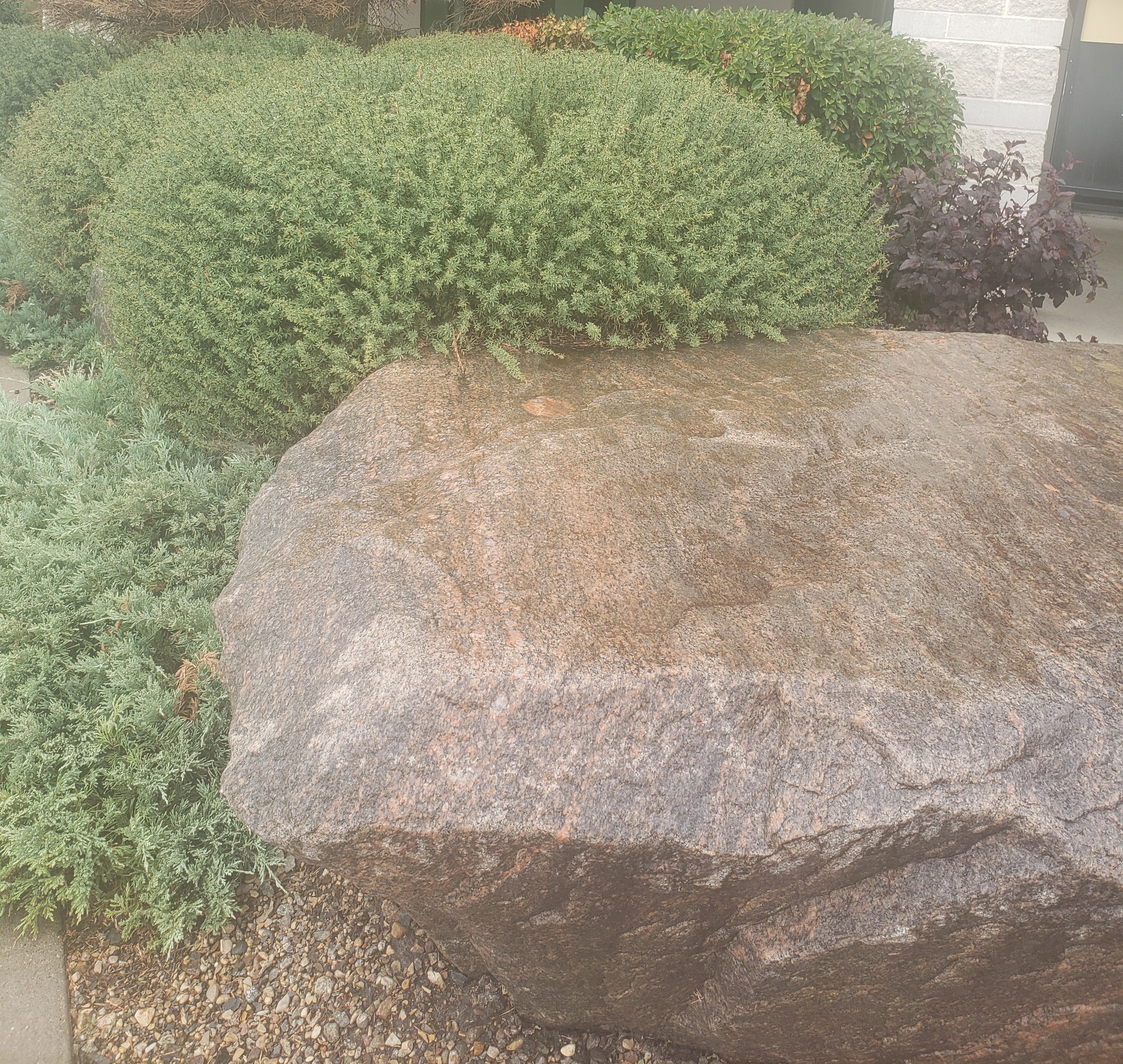
    Now, a rock is low maintenance. Brush it off in Spring, sweep it late fall and you’re done. Boulders and rocks can be very attractive in the landscape. The point of landscape design, once issues like privacy, shade, windbreak are taken care of, is to entertain and amuse the eye. Rocks can add interest, relieving endless greenery. They can provide structure as in a raised bed, seating or a platform for summer annual containers. They can come in all shapes and sizes, they come in colours that can co-ordinate or contrast with the building.

    Photo: Peace Signs & Pruners

    The photo at the left shows a charming scenario. Here on the Canadian Prairies wagon wheels are a decorative ‘thing’. This installation is on a corner lot keeping people from tramping over the grass and compacting the roots of the mature tree. It’s different, it’s interesting and the ornamental grass (undoubtedly Calamagrostis ‘Karl Foerster’) is very hardy. My only objection, as a landscape designer, is that we like things in odd numbers, and this has too many pairs. But that’s a whole other blog post. The boulder is nicely matched with a mulch of small rocks.

    The logistics of incorporating large boulders is that machinery is required to place them. Many landscape installation companies or landscape supply stores will sell rocks. The bigger the boulder, the more likely machinery will be required to move and place it. That could be two workers, a skid-steer loader and a couple of hours. That can get expensive. Smaller rocks can be loaded onto a truck or trailer at the supply store and can be moved by a wheelbarrow or even a tarp.

    Did you know there are faux rocks? Made of polymer/resin they can be quite attractive. There are large ones specifically meant to hide septic tank covers. They are easily moved, quite often coming with stakes to secure them to the ground. Take a peek at some on the website Wayfair here. As well, YouTube has instructions on making your own, just one example is here. If you really want low maintenance and have run-off issues, consider creating a dry stream bed. You can run one from your downspouts out to where your garden needs water, re-directing from your basement. Here’s some great instructions from Garden Therapy here.

    Rock on, people!

    2 comments on Rocks Are Low Maintenance
  • Boring Insects

    November 6, 2023
    Gardening, Landscape, Mother Nature, Pests, Plants
    Photo by Anastasia Kolchina on Pexels.com

    I don’t mean dull or uninteresting. I mean the types of bugs that burrow into your trees and cause damage. Every eco-system that has trees has some type of boring insect, usually the young stage of a beetle or weevil (Coleoptera). I don’t count termites in this group because, largely, they eat dead wood or lumber, not live trees. I’m sure Mother Nature considers the termite a good friend and an awesome recycler, breaking down fallen trees in the forest or jungle. Humans don’t appreciate them when they start to eat their way through the wooden infrastructure of our buildings, bridges and furniture.

    Let’s look at our native poplar borer. The adults live for just a few months in early summer. They feed on tender new growth. The female will lay eggs in furrows in the bark. The eggs hatch and the babies burrow into the tree. They can live two to four years inside a tree! They eat xylem and phloem, disrupting the flow of water and nutrients through the tree. They can munch their way right through to the heartwood and seriously compromise a tree.

    When diagnosing pests and diseases of trees and shrubs we’re looking for signs and symptoms. Signs that you have a pest include small holes in the trunk. In the case of poplar borer these are near the base or above the root flare, and may leak sap. There may be frass or sawdust at or under the hole. If woodpeckers are particularly interested in your trees you may have a boring insect. In the case of the bronze birch borer, the holes are a distinctive ‘D’ shape and are higher, usually between a human’s knee and shoulder. Symptoms of borers include die back of the top growth or side branches, swelling under the bark or sap leaking.

    Generally, our native boring insects are not a huge problem. They are part of an eco-system, they have their good years and their bad years. They have their own predators, diseases and stresses. Late frost can kill the emerging adults. Woodpeckers and nematodes can attack them, they have their own parasites and fungal diseases. Research has shown that a healthy tree is less prone to borer attacks. Some years ago the paper birch (Betula) became very popular as a landscape tree here on the Prairies. Natively, the paper birch is found in moist areas along streams, lakes, boggy areas. Homeowners bought them, plunked them in the middle of a suburban lawn and ignored them. The trees were stressed, thirsty and were attacked by bronze birch borers. Keeping your trees healthy is half the battle; choosing the right tree is the other half.

    Twenty years ago we had a class of pesticides known as systemics. These were chemicals that, to simplify, were absorbed by the woody plant, became part of the plant and bugs that ate that plant died. It was really the only way to deal with pests protected by being inside the tree. Most systemics were removed from sale to residential users in Canada for being too toxic to humans, to the birds and the bees, and to aquatic creatures. Anyone remember Cygon 2-E? I am watching, with interest, the Canadian Forest Service developing a systemic from the Neem tree called TreeAzin.

    When boring insects become a huge problem is when they are not native. They have no predators, no diseases and trees do not have a natural resistance. A recent example of a disastrous introduction is the accidental importation of the Emerald Ash Borer into North America. In it’s native Siberia, northern Russia and north Asia the beetle have predators such as parasitizing wasps. Native birds will eat the adults, but here the birds didn’t know what to make of them. The loss in mature ash trees is estimated in millions of trees and billions of dollars. Read more about it here. Another case is the disease Dutch Elm Disease, when a the Elm Bark Beetle was introduced. The beetles carried a fungus which devastated the majestic elms. Read more about it here. The loss of millions of shade trees results in loss of habitat, loss of shade and cooling, loss of windbreak.

    So what’s the homeowner to do? First and foremost, keep your trees healthy. Fertilize or amend your soil in spring, water well during times of drought. Examine your trees in Spring and Fall looking for signs and symptoms. Check the websites of your local extension service, local university or government body responsible for forests and agriculture (in Canada to Natural Resources Canada) to stay apprised of problems. Because isn’t your glorious shade tree worth a little effort?

    2 comments on Boring Insects
  • Last Chance: Winter is Coming!

    October 23, 2023
    Design, DIY, Gardening, Plants

    October has been fantastic on the Prairies. According to The Weather Network, that is about to change. This week temperatures are dropping with days barely above freezing, nights below freezing and, yes, snow by the weekend. Last chance to get a few things done in comfort.

    My Instagram is full of landscape design, gardening, houseplants and, well, animal rescues. I saw this piece last night from Shelmerdine’s, a locally-owned garden center in Winnipeg. I thought I’d share because it has a number of good points.

    View this post on Instagram

    A post shared by Shelmerdine Style (@shelmerdinestyle)

    Now is the time to change over your tired or frosted summer containers. Harvest from your own yard or from nature walks. Fill them full! This container even has the fronds of a houseplant, a palm. The container and branches can be quite neutral; you can jazz it up with mini squash or wee witches on picks for Halloween, closer to Christmas add bright baubles and lights. Once the pot freezes, it will remain quite nice looking right past New Year’s. If it is in full sun you may see some browning, but you can cover that when seasonal evergreen boughs appear in garden centers in the next month.

    Enjoy a fall walk through your garden and get ready for great containers all winter.

    1 comment on Last Chance: Winter is Coming!
Previous Page
1 … 6 7 8 9 10 … 12
Next Page

Start a Blog at WordPress.com.

Peace Signs and Pruners

Caring for Mother Nature While Making Her a Little Bit Prettier!

    • About
    • Search Categories


Loading Comments...
 

    • Subscribe Subscribed
      • Peace Signs and Pruners
      • Join 25 other subscribers
      • Already have a WordPress.com account? Log in now.
      • Peace Signs and Pruners
      • Subscribe Subscribed
      • Sign up
      • Log in
      • Report this content
      • View site in Reader
      • Manage subscriptions
      • Collapse this bar