I suppose in the modeling world there is no such thing as ‘too leggy’. Starting seeds, though, there is definitely ‘too leggy’. I had decided to start an indoor tray of seeds for cut-and-come-again lettuce. We use a lot of lettuce; almost every work day in sandwiches, salads with dinner some nights. It seemed a healthy, cost-effective thing today.
I haven’t started seeds since we sold the wee farm almost seven years ago. I was no longer really set up for it with lights, heat mats even seed trays. So I re-used a plastic pastry container from the supermarket. I’ve seen lots of posts on social media of people using rotisserie chicken containers, pastry clam shells and lidded take-out containers. It worked well.
I put the seeded tray in the sunniest spot in the apartment. It’s a bright room but only gets a couple of hours of direct light this time of year. I didn’t pay much attention for about five days because I didn’t think anything would happen for about a week. Well, imagine my surprise when I found almost full germination and everything already 4 cm (1.5″) tall!
Kudos to No Coast Seeds, a new company from Saskatchewan doing open-pollinated seeds geared for the short season of Prairie Gardens. I had the ‘Immortal Mix’, a blend of loose leaf lettuce. The germination was fast and fabulous! I found the company at Brandon’s ‘Seedy Sunday’.
I didn’t react quickly enough to get the seeds under lights so they just got taller. By the time they were getting their second set of leaves, the true leaves, they were keeling over. No, I did not have damping off, the dreaded fungal disease that affects seedlings at soil level. Learn more about that here. I just had plants that were too tall and spindly.
I tried to fix this batch by digging out some of the seedlings and re-potting, planting them deeper. I also added soil to the existing seedlings. I killed them all. Such is gardening. You win a few, a lose a few. I will now sow an outdoor container, on the balcony. I think we’re warm enough. I may add some green onion seed. Fingers crossed!
Went for a walk, and what a difference a week makes. Buds are coming out all over. From bare and brown to green and ripe; it’s a form of magic! A couple of days of summer-like temperatures and nights above freezing have really kick-started things.
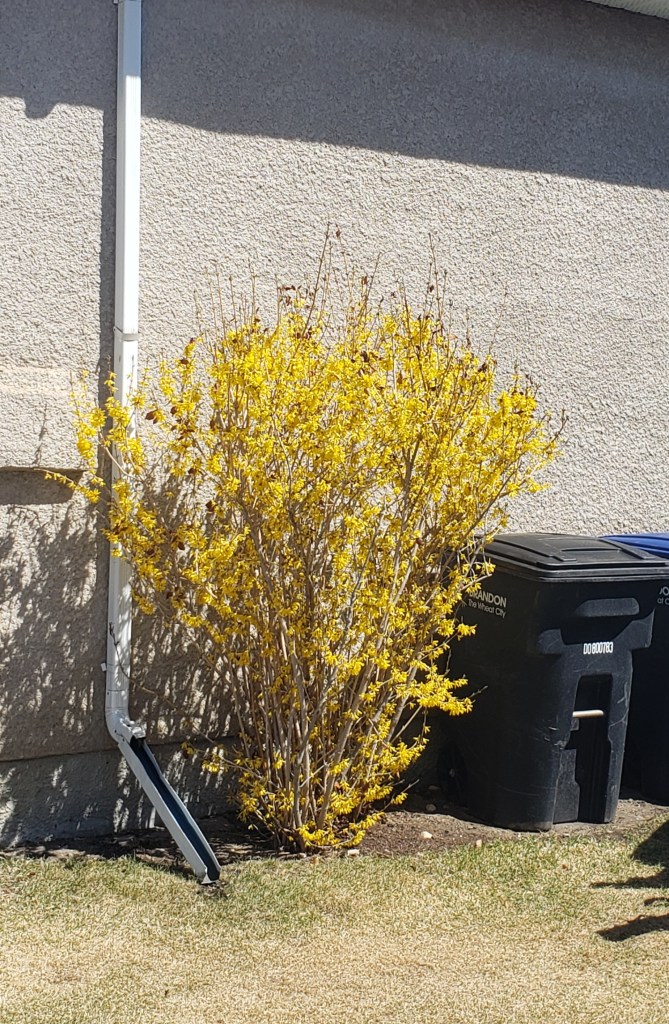
Willows are opening fluffy catkins, the purple-leaved ornamental apple trees look like they’re glowing and perennials are peeking out. The star of this stroll though was the pictured Forsythia in full, sunny yellow glory! I did notice a few other Forsythia but they were only showing buds, and all of them only part way down the stem. What’s the secret of this one?
Microclimate! Yes, a special place that every yard has, to some extent, where plants are very happy. I simplify but a microclimate is an area where conditions are different, usually better, than the rest of your garden. A microclimate can be one or two zones warmer than your area. Here’s a great, detailed explanation here.
So what’s so special about the corner where this Forsythia is? First, it is directly south-facing, lots of sun during the growing season with the heat retaining abilities of the masonry wall. It will warm up sooner in Spring and cool down slower in Fall. In the winter, when days are short and the sun is farther south, the house beside will block rays for part of the day, preventing the plant from artificially warming up even though the temperature is well below freezing. This will prevent water loss from the dormant plant.
Secondly, it is very protected from wind. Our prevailing winds are from the NW, with occasional storms coming from the NE. It is more rare to have winds coming from the south. Wind can be very drying; we see it more in evergreens which tend to brown on the windy and sunny side. This often shows in Forsythia (and other plants) only leafing out to where the snow was, the branches sticking out of the snow are dried out. Snow is our best insulator again winter damage.
Third, the plant is right beside a downspout. Anytime we are not frozen, the plant should be able to make use of any excess moisture directed through the spout and be a little healthier than something left to rely on rain alone. The area under an overhang can be an extremely dry spot. At first look, I might have though this shrub planted a little close to the house; but the downspout takes away that worry.
As a plant geek, I would certainly take advantage of this area and try all sorts of shrubs and perennials not of Zone 3. You could probably over-winter Zone 4 and perhaps even Zone 5 plants. I appreciate that the homeowners are not plant geeks and have a very pretty cover for the storage of their garbage and recycling containers.
Most of my links lead to further information. This post has affiliate links which, if you purchase through the link, I may make a teeny tiny commission. All prices as of the day of publishing and may change.
At the start of almost every season that I have worked at a garden center management has given me a pair of secaturs, or hand pruners. I’ve usually killed them before the season is over. They become wobbly, the blade won’t sharpen, the spring has fallen out and gotten lost. Admittedly, I do a lot more pruning than the average gardener. A shipment of one hundred potted trees and shrubs may arrive, and the way they are crammed on the truck at least a quarter of them have broken branches that need attention. Ultimately, I always go back to my own secaturs.
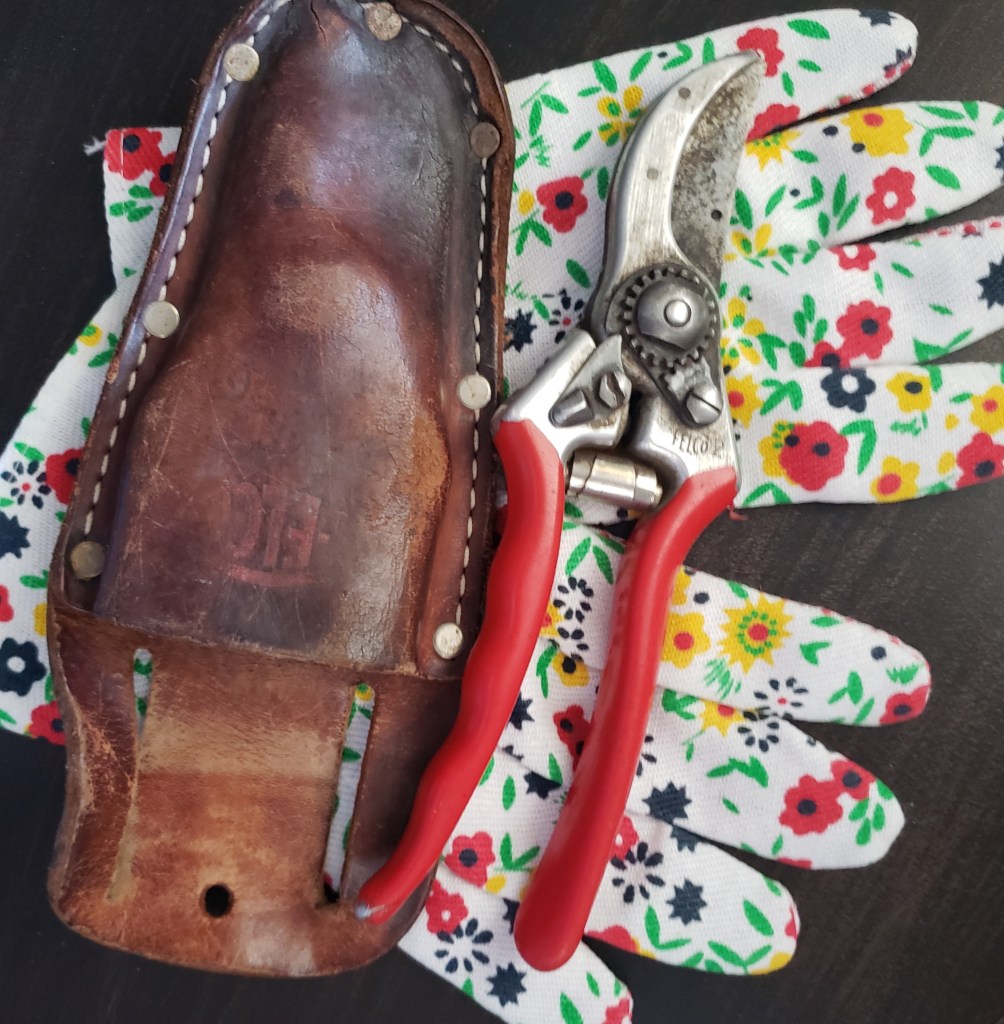
My Felco #2 and holster are over thirty years. Yes, that’s the secaturs in my profile picture. They’ve seen a lot of pruning. I purchased them during hort school, and used them while running a landscape design/build/maintenance company with my husband. As I was, at that time, certified as an arborist, I did a lot of pruning. The pruners were sharpened weekly and I’ve only had to replace the blade once. Never lost the spring. They’ve stayed balanced and strong. Our dog Teddy Bear tried teething on them, and the paint didn’t even peel off around her teeth marks. On the farm, they’ve pruned everything from raspberries to corn.
Any gardener would appreciate quality tools. Whether they are a new homeowner or someone becoming more involved in their gardening I highly recommend good pruners, like my Felco #2. If you can splurge, get them the Felco holster, too. So convenient to whip out the pruners while you’re mowing the lawn or doing some weeding. With a pair of pruners one should be able to prune anything up to the size of one’s own little finger. Anything bigger you need a pair of loppers, and bigger than one’s thumb you need a pruning saw. You can get other great accessories like sharpeners and oil.
A good set of shovels, spades, rakes and hoes are a must, and I’ve always been impressed by the tools from Lee Valley. The ash handled, ergonomic tools are something else we’ve had for decades and used more than most people would in a lifetime. This spade is a favorite. Now, the ash handled tools are more expensive…but you have to pay for top notch quality, right? I’m a huge fan of a D-hoe, also called a scuffle hoe, at Lee Valley called a Hula Hoe. The only hoe I need, a great tool!
Some other things from Lee Valley that I’ve had for decades are a steel compost bucket for under the sink, a folding plastic mat with sides for potting plants indoors and a set of small stainless steel cups perfect for dipping sauces, snacking on nuts or dried fruit, measuring out spices before starting to cook. The links to Lee Valley products are not affiliate links, I don’t think they do that. I just really like their products. Great things for gardeners, cooks, DIYers and woodworkers.
If your gift recipient is interested in vegetable gardening or houseplants there are a ton of great things. If they are a balcony gardener or have a small yard perhaps rent them a plot at a community garden. I’ve seen these raised beds in action and they’d be appreciated. They are attractive and functional; they could go at the end of a patio or deck to provide privacy, along a fence or lining a sidewalk.
If your giftee is a houseplant enthusiast or getting into starting seeds they need a set of grow lights. Grow lights must be height adjustable; the lights start very close to the seedlings and are raised as the seedling grow. Leggy seedlings come from reaching for light. I have had a system like this grow light here. It’s adjustable, lightweight and easy. I’m also a big fan of the grow bulbs that fit into any lamp, I have these grow bulbs here. I’ve currently got one in a standing lamp in my living room with houseplants around it.
Anybody starting seeds needs a heat mat, growing medium and little flats or pots. Do support your local greenhouse in this holiday season and you’ll probably find exactly what you need. For those particularly eco-friendly I’ve used this newspaper pot maker for years. Great way to upcycle newspapers, which these days are generally on unbleached paper with vegetable or soy inks. Seeds are started in 72 or 124 cell flats then potted up to the paper pots, which can be directly planted in the garden and will biodegrade. Perfect for things with brittle roots like melons and cantelopes.
For stocking stuffers and less expensive ‘Secret Santa’ gifts magazines are a great choice. For new gardeners I always choose something written for their area, information they can use. The Gardener For Canadian Climates, published four times a year or available on the newsstands is a good choice. For the dreamer or experienced gardener I adore some of the British publications like ‘Gardens Illustrated’ or ‘BBC Gardeners World’. From America there is ‘Fine Gardening’. The newbie gardener has to understand that they can’t grow half (or maybe three quarters) of the plants featured in the last three magazines but the knowledge and photography are top notch. ‘The Old Farmer’s Almanac’ is also a fun choice with weather predictions, gardening advice, animal husbandry, moon phases and so much more! Great reading on a cold winter night. There is a Canadian and an American edition.
Books on the topic are always welcome. Again, I like things that are appropriate for the area, especially for newbies. As a cold-climate gardener I have forever been a fan of writings by Lois Hole, Sara Williams, Hugh Skinner and Bob Bors. Those books are all getting old now and don’t include varieties developed in the last twenty years. Some great new plants have been introduced that aren’t mentioned or there are named varieties you can no longer buy. I’ve been quite impressed with the recent series ‘Guides For Prairie Gardeners’ by Janet Melrose and Sheryl Normandeau. With the interest in growing fruits and food I recommend this book from the series. For something more exciting and cutting-edge here’s a link to some of the recommended books from ‘Gardens Illustrated Magazine’.

 Peace Signs and Pruners