Every year, in all my years working at garden centers, people came with photos of their beds and borders. They are not happy; their beds look empty, stingy or lackluster is the complaint. Typically, they will have one of this shrub, one of that shrub and a two or three different perennials. They wished for something more…lush? Full? They don’t want to look at all the soil or mulch.
One of the best pieces of advice I received when we first moved to the farm was from a member of the local garden club, famous for her abundant borders. She told me to plant so densely that weeds could not even get started. And don’t be afraid of big plants.
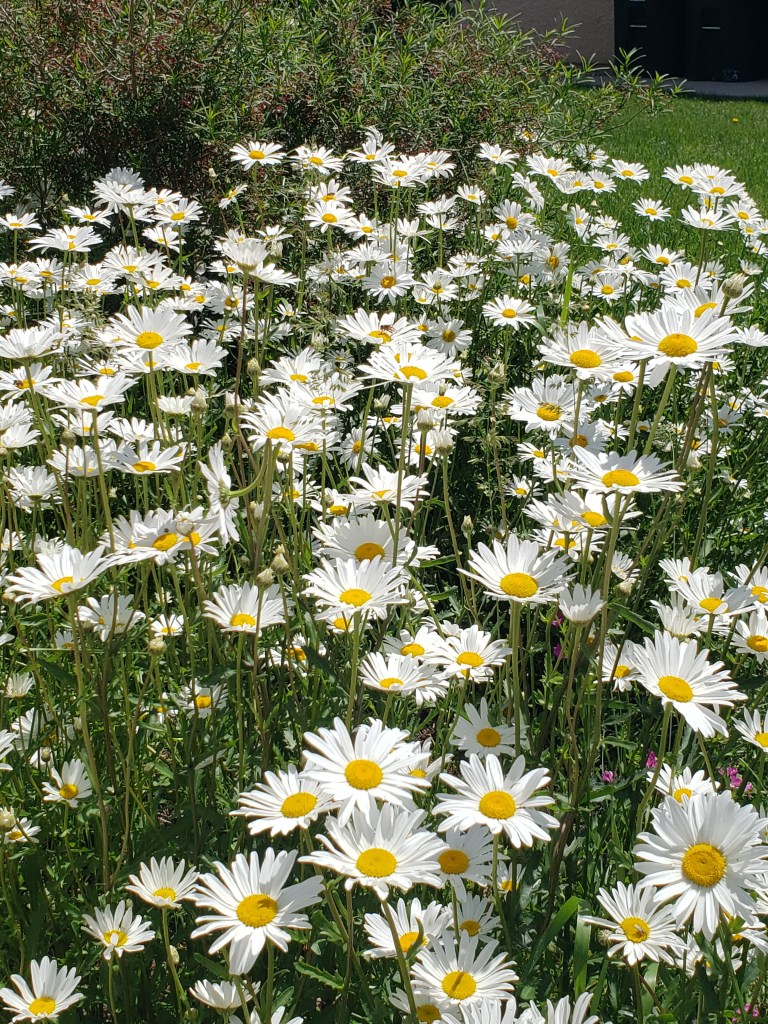
Especially when it comes to perennials, people buy one of their chosen plant. Most perennials will get to a width of maybe a foot giving you, once they are mature, a head of flowers that will fill your hands. If you want an armful of flowers, you must plant multiples of that perennial. This is known as a drift. Drifts should be in odd numbers, they can be planted in a circle, triangle or in a line within the bed. Within a few years you cannot tell where one plant begins, they grow into one large clump.
So often in Spring I see individual tulips or daffodils poking out of the emerging foliage of a perennial border. There is one here, another a foot over, another there. Once blooming they look a little lost. Planted in a drift, they have much more impact. Perennials such as daisy,(Leucanthemum), coneflower (Echinacea), salvia (Salvia) and brown-eyed Susan (Rudbeckia), just to name a few, look far more spectacular planted in a drift. Even grasses look showier planted in drifts.
If you’re trying to attract pollinators, a drift will have more power of attraction. If you want cut flowers you can remove some from a drift and the drift will still look good. Lots of good reasons to plant in multiples.
I have mentioned before that one must be careful pruning evergreens. They don’t bounce back as quickly as deciduous trees and shrubs. If you make a mistake you could be looking at a hole for a few years.
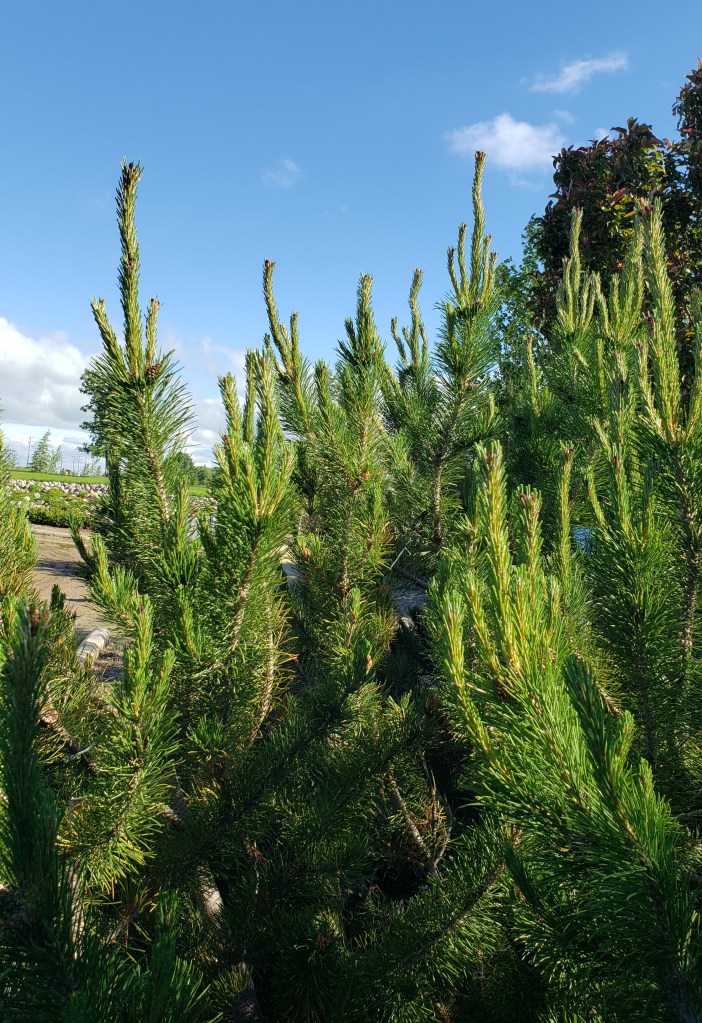
I am a little late with this post but I saw this Mugo pine and had the idea to write about it. Now, or two or three weeks ago in warmer climes, is the time to trim pines, tree and shrub forms. The new growth is not a bud like spruce or fir. It is called a candle, shown in the picture at right. The needles will unfurl for the bushy branches common but right now it is a compact, dense, upright growth.
Pruning or trimming the candles will result in a scab, often mixed with sap, but that will fall off and nobody will be able to tell anything was done. If you have dwarf pines like the Mugo you can even up growth and control the shape. You simply cut the candle where you want the tip of the branch to be. If a branch is showing two leaders you can simply snap one off at the base.
The mature Mugo pine shown is the species which can get to be a big shrub. The back of it was six feet tall, the front four to five feet. The difference is probably that the front is more exposed to winds and heat. If you would like to even off the shrub simply snap or trim off all the candles on the tallest part; they will achieve no new growth this season while the front branches will increase in height.
If you have a dwarf Mugo and would like it even in a tight half circle, trim the candles now to consistent heights. Don’t be afraid, it’s just a little pruning!
Photo by u017daneta Miu0161utovu00e1 on Pexels.com
Twenty five dollars will get you hours of fun, and tired-out children. In terms of watering your lawn and garden, an oscillating sprinkler is one of the least efficient methods available to you. The fine spray of water can be carried away by wind and can even evaporate if you’re using it in the heat of the day. If you pay for your water, that can add up over the course of the summer. The oscillating sprinkler is intended for lawns, which have shallow roots and is not appropriate for beds and borders. Sprinkler types that are lower to the ground and produce a stronger stream of water will be more effective.
Maybe you’re one of the ‘watering wand fairies’. You and your watering wand flit around the perennials and shrubs adding a little water here and there. The problem is you don’t stay in one place long enough. You’re only soaking the soil down an inch or two; your perennials and shrubs will root into those two inches and be more prone to winter freezing. Additionally, many times the foliage gets wet and can lead to fungal and bacterial leaf diseases. Experiencing black spot on roses or powdery mildew on Bee Balm or Phlox? Water the soil, not the leaves. In terms of watering well in a border or bed, you need to stand four to five minutes in each spot, maybe longer if you have a thick mulch, to really soak the soil deeply.
My favourite solution to watering well: soaker or drip hoses. You will use far less water and water your plants much better. Soaker hoses release water slowly, in targeted areas and soak down much further into the soil. The deeper the roots of your hardy plants the less prone they will be to winter root damage. Have you ever had an established shrub or tree leaf out in the spring and then die? Probably root damage: there was enough carbohydrates stored in the plant to leaf out but the roots were too damaged to pick up water and begin photosynthesis. The other thing that is fantastic about soaker hoses is that you turn them on and then walk away for half an hour or more, enjoying your family, a good book or a lovely beverage in the ensuing time!
Newly planted tree or shrub? Put your watering wand on soaker, place on the outside of the root ball you just dug, turn the water volume onto low and have a mini soaker. There’s also that old-time hack of a two litre pop bottle with some small holes punched in the bottom. Bury up to the neck beside new plantings and then top the water up as needed through the cap end. Specific, deep drip irrigation, especially beneficial if you’re trying to establish a plant among the roots of existing trees. I’ve been seeing on social media a hot trend of sinking natural terracotta pots into beds, covered with their saucers. You fill the pot and water should slowly leach through the terracotta. That’s one I’d like a bit more data on.
Are you growing fruit trees like apples, plums or pears? As the fruit is developing is when they need water, to produce the largest, most luscious fruit possible. On mature trees the most viable roots for picking up water are out past the end of the branches by at least two feet. This is so the trees can pick up rainwater well. This is where you should be watering them, not by the trunk.
Your style of watering can affect the health and longevity of your plants. Pick wisely and you’ll save time and money, and you’ll have healthier plants!
There’s a new gardening trend making the rounds of social media. It’s called chaos gardening. In it’s purest form you take a bunch of seeds of what ever you wish to grow: herbs, grasses, flowers, vegetables and/or fruit. You mix them up and then toss them around willy-nilly. Water and wait. Really! It’s that simple!
This is the antithesis of formal gardening. If you’re not sure what a formal garden is think palaces. The gardens of Versailles are one of the best known examples. The gardens are severely structured with straight lines, precise hedging, clipped and shaped topiaries and perhaps a maze. They ultimately were created to showcase the power and prestige of the owner, demonstrating their control over Mother Nature.
Chaos gardening is allowing Mother Nature to rule. Whatever sprouts and grows goes! A chaotic garden will be a jumble of plants, colour and foliage. Peas will try to climb up milkweed or other tall flowers, beans may just grow along the ground. I believe the trend took off in the last few years as people became more interested in reducing (demanding) lawns and supporting pollinating insects, with a move first to natural or meadow gardens. Chaos gardening is the meadow freed from all restrictions or designs.
Nothing can ever be too simple, right? There are a few issues that must be dealt with for success. A basic rule of planting seeds is that they are buried to a depth three times their width. So, if you wish to grow winter squash (a large seed) and lettuce (a small seed) something is not going to be happy enough to sprout. If may be necessary to divide your seed stash into sizes. Fling around the large seeds, then cover with a light layer of soil. Broadcast medium seeds then cover with a light layer of soil. Finally, your small seeds can be cast about.
What you choose to grow is entirely up to you. I lot of what I’m seeing is people using up their seed stashes, vegetable or flower seeds that may be many years old. That’s fantastic, but you may get spotty germination. Some people are looking to create wildflower or native gardens. I’d advise that you not buy the wildflower mixes in box stores and some garden centres because they may not be formulated for your area. If you want a lot of this garden to come back next year choose hardy perennials seeds, native seeds from a local grower or self-seeding annuals. Do a little research because what just barely survives for me on the Canadian Prairies may be considered invasive in the warmer climate of southern Ontario or BC. Think of kudzu, the plant over-taking the southern US. Originally introduced as a pretty, fast growing vine from the Orient it is now clogging waterways and strangling trees.
I’m not sure chaos gardening is for the new gardener. Would a new gardener recognize a cucumber plant? Would they know to go looking for zucchini under the big mound of leaves? I’m still not sure what the parameters are for weeding. Does one accept all plants? Dandelions? Stinging Nettle? If you’re in a short season climate like mine we will not be able to broadcast seed for long season crops like tomato, pepper and some herbs and expect to get a crop. Us cold-climate gardeners will still have to start those seeds inside late winter and plant them out. Do we toss the pot into the chaos garden and then plant where it lands?
I’ll be watching some of the social media accounts engaged in this; it will be interesting to see their successes and failures. If you’d like to learn more here’s a article after chaos gardening appeared at the vaunted Chelsea Flower Show in England and here’s one from one of my favourite blogs The Spruce. Is this a trend you’ll try? Or do you like a bit more control in your borders?
It’s started. On our Manitoba gardening Facebook pages people are posting pictures of damaged plants. I’m sure this has been happening for a while in warmer climates. The person posting stated that it was so nice this day they moved their annuals, seedlings or houseplants outside. To a fully exposed, sunny site. All day.
Now, I wouldn’t take my parka-wearing self to a tropical climate and throw myself on the beach in a bathing suit without lots and lots of sunscreen and some shade. Unfortunately, they haven’t developed sunscreen for plants. Like humans, plants can develop a ‘tan’ over time. They must be introduced to being outside gradually. It’s called acclimatizing or hardening off.
Remember, windows block a certain amount of the sun’s spectrum. So does greenhouse plastic. In your home or at the greenhouse, growers having been babying plants with constant temperatures, appropriate humidity and maybe a fan to create sturdy stems on seedlings. When the plants find themselves exposed to drying winds and burning sun damage occurs. It can be fatal.
Get your plants used to being outdoors gradually. Set them out in a shady spot out of the wind for an hour or two the first few days. If you work fulltime maybe a house or garage window with the window open but not on the sunny side. Increase the time gradually and slowly move them to a sunnier spot. It can take two to three weeks to harden off your plants. Keep an eye on temperature! Last night in Manitoba, Mother’s Day, the temperature got down to 1o Celsius (33o F.) That would be quite shocking to your annual Impatiens that originated on the African continent.
Take a deep breath. Slow down. Take your time so you have beautiful, healthy plants to enjoy right through to Fall.




 Peace Signs and Pruners