It’s started. On our Manitoba gardening Facebook pages people are posting pictures of damaged plants. I’m sure this has been happening for a while in warmer climates. The person posting stated that it was so nice this day they moved their annuals, seedlings or houseplants outside. To a fully exposed, sunny site. All day.
Now, I wouldn’t take my parka-wearing self to a tropical climate and throw myself on the beach in a bathing suit without lots and lots of sunscreen and some shade. Unfortunately, they haven’t developed sunscreen for plants. Like humans, plants can develop a ‘tan’ over time. They must be introduced to being outside gradually. It’s called acclimatizing or hardening off.
Remember, windows block a certain amount of the sun’s spectrum. So does greenhouse plastic. In your home or at the greenhouse, growers having been babying plants with constant temperatures, appropriate humidity and maybe a fan to create sturdy stems on seedlings. When the plants find themselves exposed to drying winds and burning sun damage occurs. It can be fatal.
Get your plants used to being outdoors gradually. Set them out in a shady spot out of the wind for an hour or two the first few days. If you work fulltime maybe a house or garage window with the window open but not on the sunny side. Increase the time gradually and slowly move them to a sunnier spot. It can take two to three weeks to harden off your plants. Keep an eye on temperature! Last night in Manitoba, Mother’s Day, the temperature got down to 1o Celsius (33o F.) That would be quite shocking to your annual Impatiens that originated on the African continent.
Take a deep breath. Slow down. Take your time so you have beautiful, healthy plants to enjoy right through to Fall.
Went for a walk, and what a difference a week makes. Buds are coming out all over. From bare and brown to green and ripe; it’s a form of magic! A couple of days of summer-like temperatures and nights above freezing have really kick-started things.
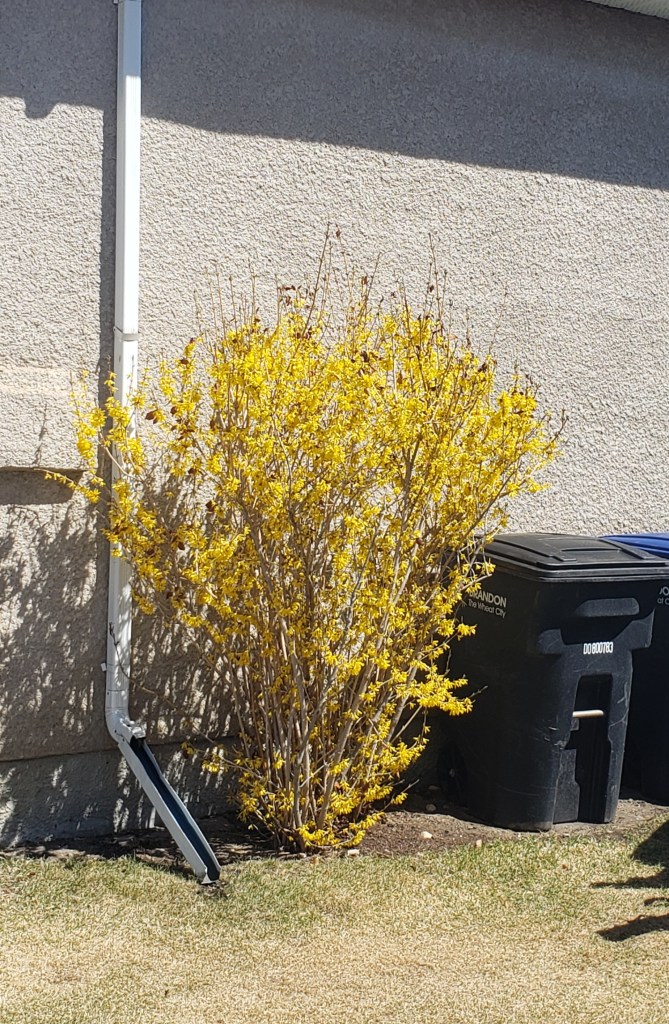
Willows are opening fluffy catkins, the purple-leaved ornamental apple trees look like they’re glowing and perennials are peeking out. The star of this stroll though was the pictured Forsythia in full, sunny yellow glory! I did notice a few other Forsythia but they were only showing buds, and all of them only part way down the stem. What’s the secret of this one?
Microclimate! Yes, a special place that every yard has, to some extent, where plants are very happy. I simplify but a microclimate is an area where conditions are different, usually better, than the rest of your garden. A microclimate can be one or two zones warmer than your area. Here’s a great, detailed explanation here.
So what’s so special about the corner where this Forsythia is? First, it is directly south-facing, lots of sun during the growing season with the heat retaining abilities of the masonry wall. It will warm up sooner in Spring and cool down slower in Fall. In the winter, when days are short and the sun is farther south, the house beside will block rays for part of the day, preventing the plant from artificially warming up even though the temperature is well below freezing. This will prevent water loss from the dormant plant.
Secondly, it is very protected from wind. Our prevailing winds are from the NW, with occasional storms coming from the NE. It is more rare to have winds coming from the south. Wind can be very drying; we see it more in evergreens which tend to brown on the windy and sunny side. This often shows in Forsythia (and other plants) only leafing out to where the snow was, the branches sticking out of the snow are dried out. Snow is our best insulator again winter damage.
Third, the plant is right beside a downspout. Anytime we are not frozen, the plant should be able to make use of any excess moisture directed through the spout and be a little healthier than something left to rely on rain alone. The area under an overhang can be an extremely dry spot. At first look, I might have though this shrub planted a little close to the house; but the downspout takes away that worry.
As a plant geek, I would certainly take advantage of this area and try all sorts of shrubs and perennials not of Zone 3. You could probably over-winter Zone 4 and perhaps even Zone 5 plants. I appreciate that the homeowners are not plant geeks and have a very pretty cover for the storage of their garbage and recycling containers.
If you’re a Prairie gardener, April is the hardest month of the gardening year. My social media feeds, for months, have been filled with blossoms and buds. I follow blogs and creators from around the globe so I’ve been forced to endure lovely witch hazel blooms since just after the New Year. Then it has been the cherry blossoms, now the magnolias and rhododendrons.
Meanwhile, on the Canadian Prairies March was still winter. Then, in April we started to see some warming trends. The snow pack started to recede, then it snowed and got cold again. It would get above freezing during the day, then freeze at night making for icy, dangerous roads and sidewalks. Then it snowed a bit again, about the time of the Eclipse. The last two days the weather has been like summer, highs in the low 20’s Celsuis (68o F.) By Saturday night we’re going to be below freezing again!
As the snow recedes, what is revealed is not pretty. Brown grass, sometimes with a white scurf known as snow mould. Barren shrubs, desiccated foliage of perennials, masses of slimy, wet leaves. And on many driveways and parking lots huge mounds of snow from the removal crews that are gray from the road sand and full of garbage. Not very attractive.
These unpredictable temperatures are one of the reasons it is really hard to harvest apricots in Zone 3. We can grow the trees but it is hard to get fruit. Anything that blooms early in the season, meaning most fruit, made the flower buds last fall. They’ve been sitting, well protected, waiting for conditions to be right. The apricot, unfortunately, is just a little too enthusiastic and may have started to open buds. They may got frosted off Saturday night when freezing temperatures return. Hence, no fruit.
The other thing that is so difficult for me is the pictures of all the plants I love but can no longer grow. We came from the West Coast, Zone 8/9. We find ourselves in Zone 3. I adore witch hazel with those spikey, funky flowers and light fragrance. Hmmm, and magnolias, with those large waxy flowers! The Kousa dogwoods, Japanese cherries, magnificent rhododendrons, hellebores, even delightful snowdrops are hard to over-winter here.
Ah, but soon…the weather will stabilize and forsythias will go off. Well, usually branches under the snow pack will bloom. The tops sticking out of the snow may be too dessicated. You see? It’s hard to be a Prairie gardener!
Bee City Brandon in Manitoba has created a beautiful calendar for 2024. It’s a fundraiser for the re-wilding of Eleanor Kidd Garden, a treasure destroyed but flooding. Orders should be in by November 18th.
The calendar would be a great Christmas gift for so many people! First, it’s beautiful; the photography by local artist Cynthia Korman is stunning. Any nature lover would adore this. Any gardener interested in beautiful, hardy plants would love this, and learn new things all year! Anyone interested in helping pollinators would make good use of this. Anyone interested in native plants on the Prairies would value this calendar. Teachers could use it in the classroom.
The calendar is raising funds to rehabilitate the now derelict park. The City of Brandon has no funds available (think new bridge), and must consider the costs of investing in a park that may flood again in future years. That is why they invited Bee City Brandon to develop a pollinator-friendly, native garden that could be beautiful and withstand flooding.
The calendar is just one of the many ways Bee City Brandon is raising money. The committee has been applying for grants and working on other projects. The work will be almost entirely be done by volunteers so if you’re in Brandon, with fond memories of Eleanor Kidd Garden, sign up here to volunteer some weeding or planting new year. Hopefully I’ll see you there!
I don’t mean dull or uninteresting. I mean the types of bugs that burrow into your trees and cause damage. Every eco-system that has trees has some type of boring insect, usually the young stage of a beetle or weevil (Coleoptera). I don’t count termites in this group because, largely, they eat dead wood or lumber, not live trees. I’m sure Mother Nature considers the termite a good friend and an awesome recycler, breaking down fallen trees in the forest or jungle. Humans don’t appreciate them when they start to eat their way through the wooden infrastructure of our buildings, bridges and furniture.
Let’s look at our native poplar borer. The adults live for just a few months in early summer. They feed on tender new growth. The female will lay eggs in furrows in the bark. The eggs hatch and the babies burrow into the tree. They can live two to four years inside a tree! They eat xylem and phloem, disrupting the flow of water and nutrients through the tree. They can munch their way right through to the heartwood and seriously compromise a tree.
When diagnosing pests and diseases of trees and shrubs we’re looking for signs and symptoms. Signs that you have a pest include small holes in the trunk. In the case of poplar borer these are near the base or above the root flare, and may leak sap. There may be frass or sawdust at or under the hole. If woodpeckers are particularly interested in your trees you may have a boring insect. In the case of the bronze birch borer, the holes are a distinctive ‘D’ shape and are higher, usually between a human’s knee and shoulder. Symptoms of borers include die back of the top growth or side branches, swelling under the bark or sap leaking.
Generally, our native boring insects are not a huge problem. They are part of an eco-system, they have their good years and their bad years. They have their own predators, diseases and stresses. Late frost can kill the emerging adults. Woodpeckers and nematodes can attack them, they have their own parasites and fungal diseases. Research has shown that a healthy tree is less prone to borer attacks. Some years ago the paper birch (Betula) became very popular as a landscape tree here on the Prairies. Natively, the paper birch is found in moist areas along streams, lakes, boggy areas. Homeowners bought them, plunked them in the middle of a suburban lawn and ignored them. The trees were stressed, thirsty and were attacked by bronze birch borers. Keeping your trees healthy is half the battle; choosing the right tree is the other half.
Twenty years ago we had a class of pesticides known as systemics. These were chemicals that, to simplify, were absorbed by the woody plant, became part of the plant and bugs that ate that plant died. It was really the only way to deal with pests protected by being inside the tree. Most systemics were removed from sale to residential users in Canada for being too toxic to humans, to the birds and the bees, and to aquatic creatures. Anyone remember Cygon 2-E? I am watching, with interest, the Canadian Forest Service developing a systemic from the Neem tree called TreeAzin.
When boring insects become a huge problem is when they are not native. They have no predators, no diseases and trees do not have a natural resistance. A recent example of a disastrous introduction is the accidental importation of the Emerald Ash Borer into North America. In it’s native Siberia, northern Russia and north Asia the beetle have predators such as parasitizing wasps. Native birds will eat the adults, but here the birds didn’t know what to make of them. The loss in mature ash trees is estimated in millions of trees and billions of dollars. Read more about it here. Another case is the disease Dutch Elm Disease, when a the Elm Bark Beetle was introduced. The beetles carried a fungus which devastated the majestic elms. Read more about it here. The loss of millions of shade trees results in loss of habitat, loss of shade and cooling, loss of windbreak.
So what’s the homeowner to do? First and foremost, keep your trees healthy. Fertilize or amend your soil in spring, water well during times of drought. Examine your trees in Spring and Fall looking for signs and symptoms. Check the websites of your local extension service, local university or government body responsible for forests and agriculture (in Canada to Natural Resources Canada) to stay apprised of problems. Because isn’t your glorious shade tree worth a little effort?


 Peace Signs and Pruners