I have mentioned before that one must be careful pruning evergreens. They don’t bounce back as quickly as deciduous trees and shrubs. If you make a mistake you could be looking at a hole for a few years.
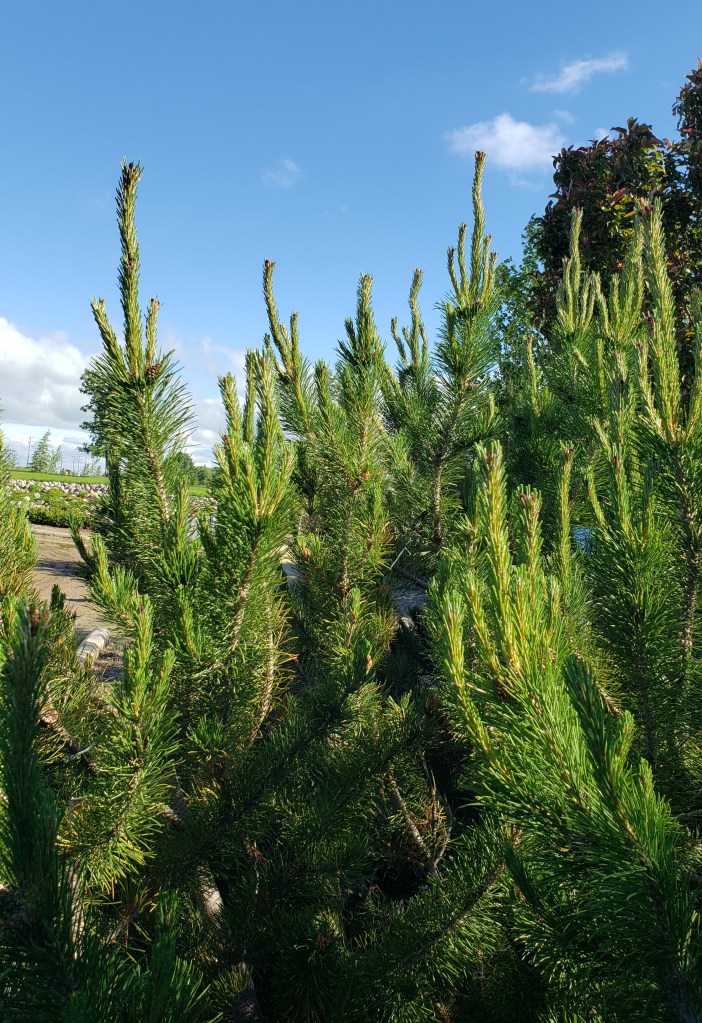
I am a little late with this post but I saw this Mugo pine and had the idea to write about it. Now, or two or three weeks ago in warmer climes, is the time to trim pines, tree and shrub forms. The new growth is not a bud like spruce or fir. It is called a candle, shown in the picture at right. The needles will unfurl for the bushy branches common but right now it is a compact, dense, upright growth.
Pruning or trimming the candles will result in a scab, often mixed with sap, but that will fall off and nobody will be able to tell anything was done. If you have dwarf pines like the Mugo you can even up growth and control the shape. You simply cut the candle where you want the tip of the branch to be. If a branch is showing two leaders you can simply snap one off at the base.
The mature Mugo pine shown is the species which can get to be a big shrub. The back of it was six feet tall, the front four to five feet. The difference is probably that the front is more exposed to winds and heat. If you would like to even off the shrub simply snap or trim off all the candles on the tallest part; they will achieve no new growth this season while the front branches will increase in height.
If you have a dwarf Mugo and would like it even in a tight half circle, trim the candles now to consistent heights. Don’t be afraid, it’s just a little pruning!
Welcome to the first day of summer. The longest day of the year, the promise of those lazy, hazy crazy days of summer as so aptly put by Nat King Cole.
Summer solstice is rather bittersweet for this cold climate gardener. The days begin to get shorter now and it always seems to me they shorten more quickly than they lengthen through the Spring. Our growing season is so brief here on the Canadian Prairies. I have a picture on my camera from May 8th, with trees budding but not yet in leaf. By October 8th the trees may very well be dropping their leaves.
Everything happens so quickly; the apples, pears and plums looked glorious…for a couple of weeks. They’re now finished blooming and the fruits are developing but the fruits are wee and green and blend into the foliage. Lilacs are in bloom, those too will be finished shortly. Spring blooming perennials are finishing, summer bloomers are in bud.
It’s also a Full Moon tonight – the Strawberry Full Moon. According to a couple of sources, such as Space.com, the name was bestowed by Algonquin tribes because this was the time to be picking strawberries. The Algonquin tribes were definitely in a cold climate because the strawberries are just ripening here on the Prairies. Friends on the West Coast have been picking strawberries for three or four weeks now.
So, do enjoy the first day of summer. Go howl at the Full Moon. And do stop to smell the flowers while you can.
Photo by u017daneta Miu0161utovu00e1 on Pexels.com
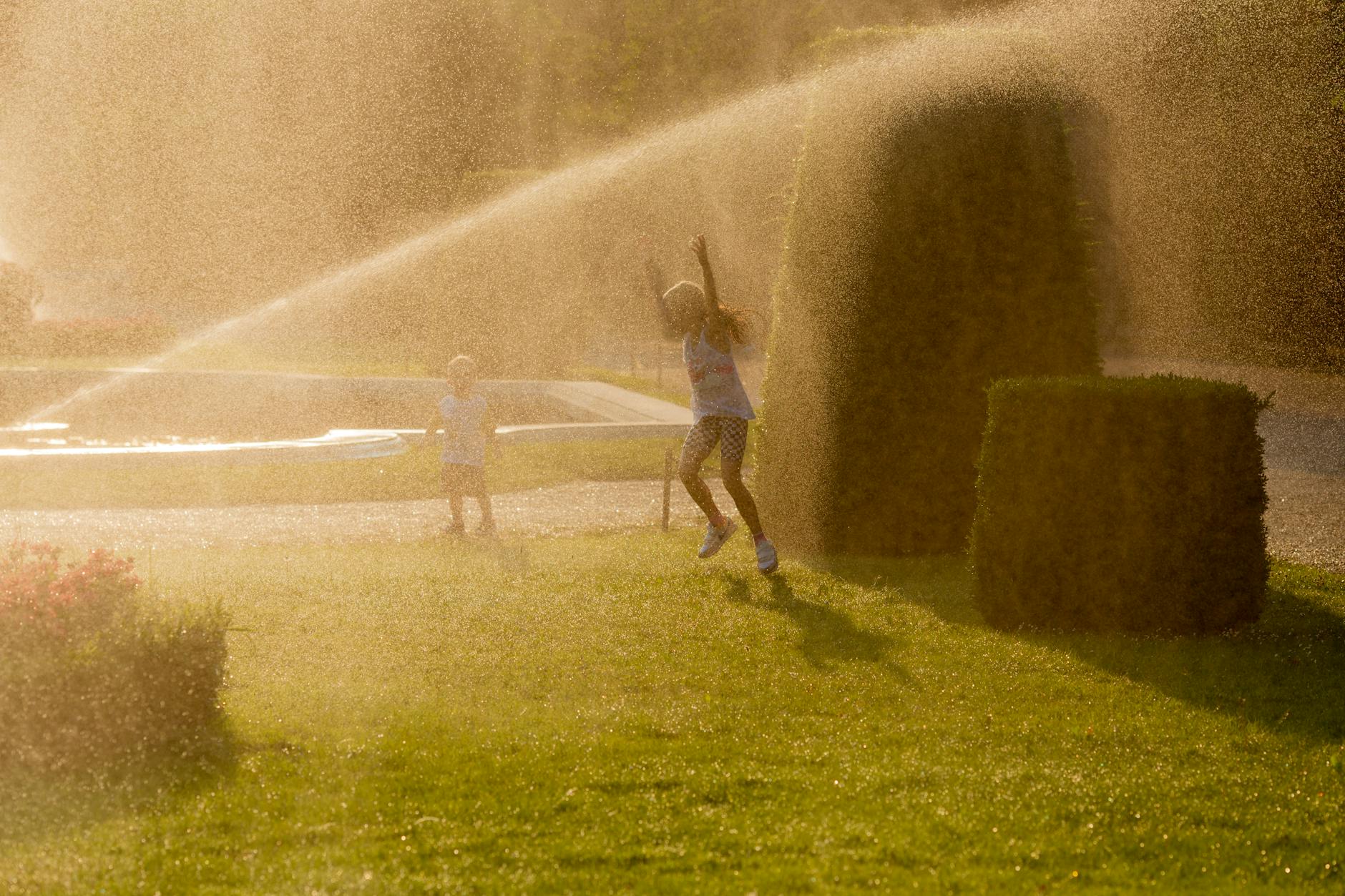
Twenty five dollars will get you hours of fun, and tired-out children. In terms of watering your lawn and garden, an oscillating sprinkler is one of the least efficient methods available to you. The fine spray of water can be carried away by wind and can even evaporate if you’re using it in the heat of the day. If you pay for your water, that can add up over the course of the summer. The oscillating sprinkler is intended for lawns, which have shallow roots and is not appropriate for beds and borders. Sprinkler types that are lower to the ground and produce a stronger stream of water will be more effective.
Maybe you’re one of the ‘watering wand fairies’. You and your watering wand flit around the perennials and shrubs adding a little water here and there. The problem is you don’t stay in one place long enough. You’re only soaking the soil down an inch or two; your perennials and shrubs will root into those two inches and be more prone to winter freezing. Additionally, many times the foliage gets wet and can lead to fungal and bacterial leaf diseases. Experiencing black spot on roses or powdery mildew on Bee Balm or Phlox? Water the soil, not the leaves. In terms of watering well in a border or bed, you need to stand four to five minutes in each spot, maybe longer if you have a thick mulch, to really soak the soil deeply.
My favourite solution to watering well: soaker or drip hoses. You will use far less water and water your plants much better. Soaker hoses release water slowly, in targeted areas and soak down much further into the soil. The deeper the roots of your hardy plants the less prone they will be to winter root damage. Have you ever had an established shrub or tree leaf out in the spring and then die? Probably root damage: there was enough carbohydrates stored in the plant to leaf out but the roots were too damaged to pick up water and begin photosynthesis. The other thing that is fantastic about soaker hoses is that you turn them on and then walk away for half an hour or more, enjoying your family, a good book or a lovely beverage in the ensuing time!
Newly planted tree or shrub? Put your watering wand on soaker, place on the outside of the root ball you just dug, turn the water volume onto low and have a mini soaker. There’s also that old-time hack of a two litre pop bottle with some small holes punched in the bottom. Bury up to the neck beside new plantings and then top the water up as needed through the cap end. Specific, deep drip irrigation, especially beneficial if you’re trying to establish a plant among the roots of existing trees. I’ve been seeing on social media a hot trend of sinking natural terracotta pots into beds, covered with their saucers. You fill the pot and water should slowly leach through the terracotta. That’s one I’d like a bit more data on.
Are you growing fruit trees like apples, plums or pears? As the fruit is developing is when they need water, to produce the largest, most luscious fruit possible. On mature trees the most viable roots for picking up water are out past the end of the branches by at least two feet. This is so the trees can pick up rainwater well. This is where you should be watering them, not by the trunk.
Your style of watering can affect the health and longevity of your plants. Pick wisely and you’ll save time and money, and you’ll have healthier plants!
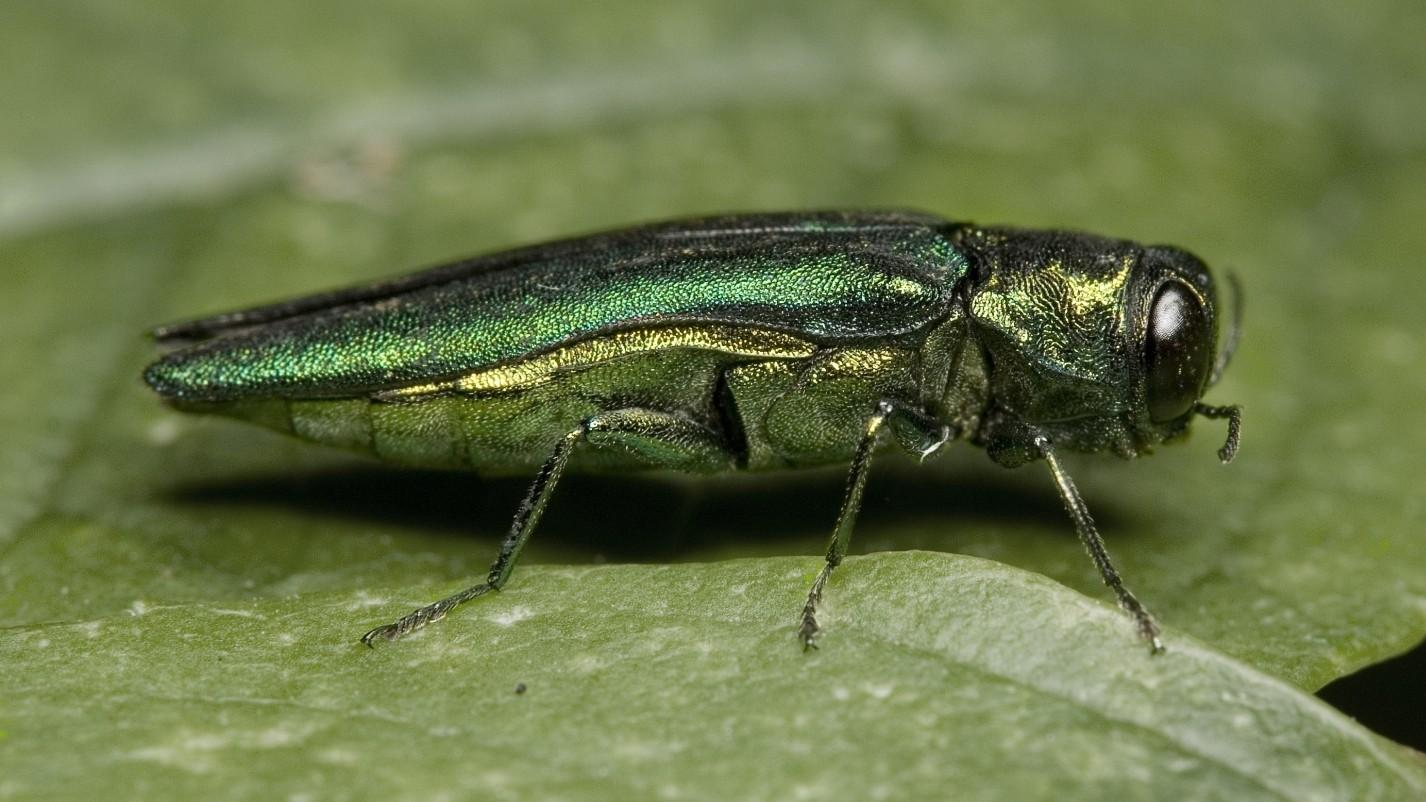
The Canadian Food Inspection Agency has announced that Emerald Ash Borer has been discovered in Vancouver, BC. If you’re not familiar, EAB is an extremely harmful pest imported from Asia on shipping materials like ash-wood pallets. It is extremely harmful because it loves ash trees (Fraxinus) and has no natural predators in North America.
Those of you of a certain age will remember the devastation caused by Dutch Elm Disease (DED), a fungal disease that, again, probably arrived in wood pallets made of elm. Our native elm beetles munched on the pallets, ingested the disease and then spread it to our native elms. Our native elms had not evolved any defence to this foreign invader and millions of elms died. The elm is a hardy, tough, glorious shade tree that had been widely planted on the Prairies. Suddenly, main streets, parks and home landscapes were bare, with a loss of shade, loss of habitat for birds and small critters, increases in wind speeds and, well, just a huge loss of natural beauty.
The Emerald Ash Borer lays eggs on the bark which hatch, burrow in and then tunnel their way through the tree, disrupting the vessels that carry water and nutrients up and down the tree. Programs in the U.S. and Canada have not had much success killing the beetles; the young beetles are well protected inside the tree and the window of opportunity to kill the adults as they emerged in the spring to lay eggs was very small.
Like DED, the losses to EAB can be devastating to habitat, loss of cooling effect and the beauty of parks and gardens. This is amplified now by the threat of forest fires; dead, dry trees in the environment provide excellent fuel.
It is believed EAB first landed in ports in Detroit, Michigan and Windsor Ontario in 2002, affecting our native green and black ash. These species grow mainly in colder climates in east and central Canada and the US. It was hoped that the extreme cold of the Prairies would stop the bug, but it has over-wintered in Manitoba. There are other native ash species in the west in California, Oregon and as far south as the Carolinas in the US. There’s an excellent article here on all the North American species. The fear for horticulturalists is that the bug can now spread from the west out and south.
So, please do ‘due diligence’. There will be bans on transporting ash firewood, much as there are bans on moving elm wood. Nurseries in the west of Canada and the US may quit carrying stock of ash trees.
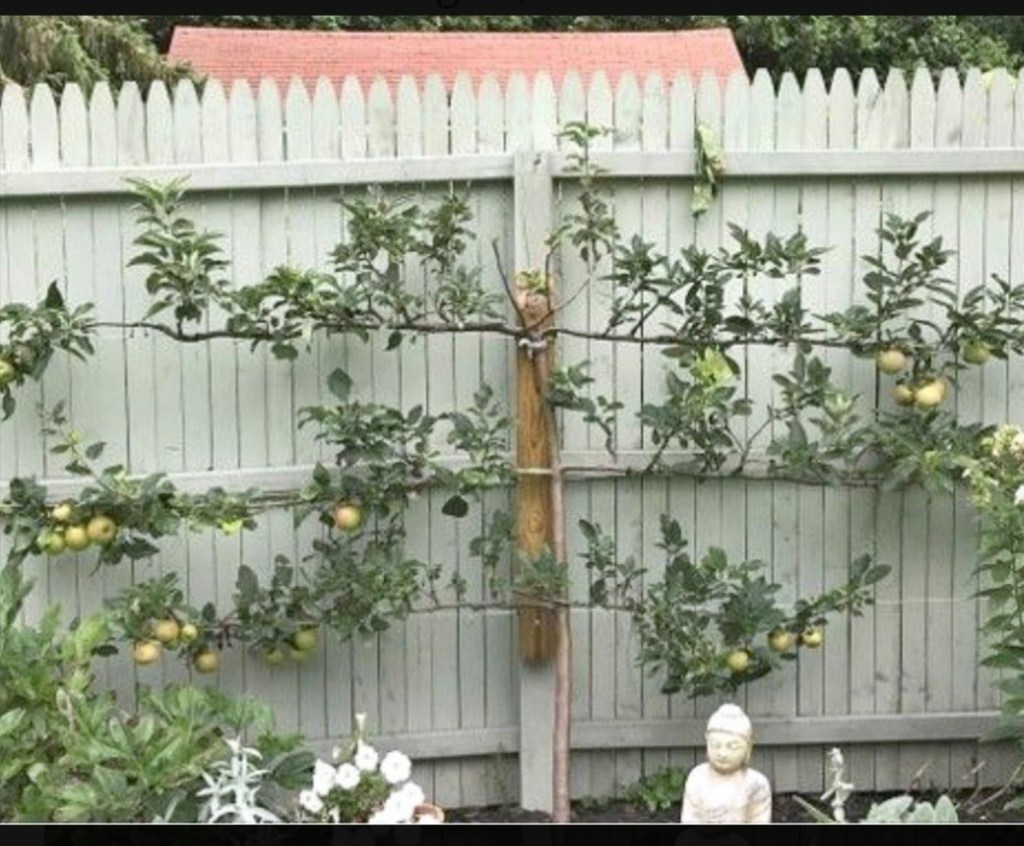
Much as you’d love to grow more of your own food, you say you have no room for fruit trees? I beg to differ! Let me introduce you to the ancient art of espalier. If you’ve ever visited a vineyard, or seen pictures of one, you’ve probably seen espalier in action. It is the process of growing horizontally, or flat, on trellis, fence or wall.
There is evidence of the use of espalier in Roman times. It became very popular in Medieval times, when people lived in walled castles; the possibility of sieges caused gardeners to grow as much food as possible in small spaces. Plants like roses could be grown to beautify the stone walls of small courtyards, as well as fruit trees to provide sustenance. Home gardeners started using the technique to provide for their families, even in a tiny cottage garden a fruit tree could be grown.
The science of espalier is based on the theory that less branches and leaves, the more energy to produce fruit. The plants are grown on a frame of trellising or using wires attached to rings or screws. A fan shape is common but almost any shape can be achieved. Grapes are grown on fences so that all the branches and fruit are between shoulder and knee height, making the maintenance and harvesting of fruit easily within reach.
Espaliered fruit needs to be in full sun; at least eight hours per day. They are often grown on the walls of the house or on fences, providing protection from weather as well as creating a ‘heat sink’ as the building absorbs heat during the day and releases it slowly in the evening. A young tree is planted, and then any branches or shoots growing backwards or forward are pruned out. As the plant begins to grow in Spring tender new shoots are attached to the frame. Like bonsai, the manipulation begins when the young shoots are pliable; by the end of our growing season the new branches harden and become too woody to change.
It may sound complicated, but it’s not really! The work, for us in Manitoba, will mostly be in May and June, when the tree is actively growing. You perform your pruning and tying in then; some growth will occur through the summer and the tree can be tidied up in fall. Best choices for fruit? If you are only going to try one espalier, apples are probably the easiest as they are readily pollinated by ornamental crabapples as well as other apples and you probably have a pollinator within your neighbourhood. A pollinator needs to be within a couple of city blocks and the birds and the bees will do the rest. Plums are very choosy about what will pollinate what, pears and apricots need a pollinator but you may not have one close enough in the neighbourhood. Hardy grapes can easily be two plants on the same framework, giving in-house pollination.
The framework is often o-screws or cup hooks, with sturdy fishing line or light wire strung between points. Bamboo or willow poles can be used as well. Your plant needs to be away from the wall or fence by at least six inches so that there is good air circulation around the plant. There are many detailed instructions online such as on YouTube, just search ‘espalier’. Give it a try on a sunny fence and enjoy your homegrown fruit!
This article first appeared in the magazine ‘Neighbors of 34th Street. It has been updated and revised.
 Peace Signs and Pruners